


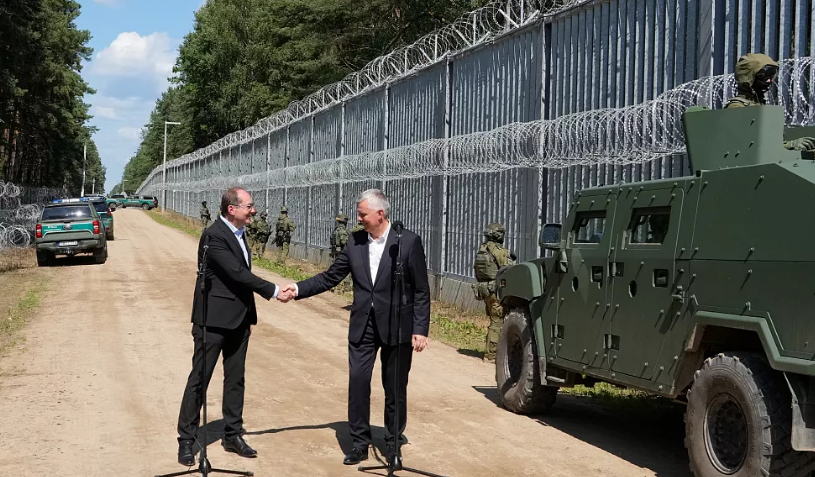
German Interior Minister Alexander Dobrindt has commended Poland’s approach to border control during a visit to the Polish-Belarusian frontier on Monday, calling it an example of “effective external border protection” that has had a significant impact on regional security.
Speaking alongside his Polish counterpart, Tomasz Siemoniak, Dobrindt described Poland as one of Germany’s closest partners in the European Union, stating: “Poland is Germany’s most important partner within the EU, alongside our French neighbours.” His visit comes as both countries navigate rising migration pressures and shared concerns over border security.
Poland has fortified its border with Belarus with a high steel barrier and electronic surveillance, following claims from Warsaw that Russia and Belarus are deliberately encouraging migrants to cross into Polish territory in an attempt to destabilise Poland and the EU. Prime Minister Donald Tusk’s government has taken a tough stance on the issue, reinforcing border controls and enacting controversial measures such as the suspension of asylum applications from Belarus, which can be extended for 60 days at a time.
The move has drawn criticism from human rights organisations but enjoys support from German officials. “It is a problem that Russia and Belarus are trying to use migration as a weapon,” Dobrindt said. He praised Poland’s response, calling it an essential line of defence for the EU as a whole.
Both countries have introduced temporary border checks in recent months, including at their shared 467-kilometre frontier, despite being part of the EU’s Schengen Area, which normally allows passport-free travel. Germany began its own controls in 2023 to tackle human trafficking and irregular migration, with Chancellor Friedrich Merz ramping up enforcement since taking office in May. These measures include the deployment of more border police and the authority to turn away some asylum seekers.
Poland followed suit earlier this month by imposing its own checks along borders with Germany and Lithuania, citing concerns that migrants were being transported into the country after arriving in Western Europe. On Monday, both interior ministers said these reciprocal controls are temporary and that their mutual goal is to remove them once external EU borders are more effectively protected.
Despite growing political pressure over immigration in both countries, officials emphasised the importance of cooperation. “The aim is to manage the situation together and protect the EU’s borders more comprehensively,” said Dobrindt.
The show of unity reflects a broader effort by Germany and Poland to reinforce their shared security interests while balancing public concerns over migration and adherence to EU rules.
