


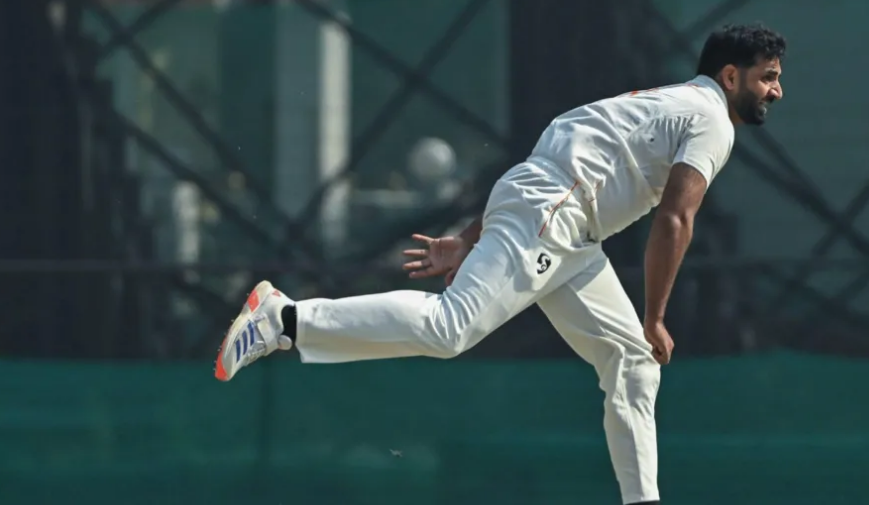
Auqib Nabi’s childhood prediction that one day cricket stars would ask him for selfies has become reality after the 29-year-old all-rounder made history as the first cricketer from Jammu and Kashmir to receive an India Test call-up.
Nabi was added to India’s squad for the two-match series against Sri Lanka, which begins on 15 August, after replacing Jasprit Bumrah. His selection represents a major milestone for a region where sporting opportunities have long been restricted by limited infrastructure, harsh winters and years of conflict.
Raised in a village in Baramulla district, Nabi began playing cricket on local grounds with few facilities. His father, Ghulam Nabi Dar, initially wanted him to focus on education and become a doctor.
“There was no scope in cricket,” his father said, recalling how he once believed pursuing sport was a waste of time. His view changed after seeing his son’s commitment to the game, and he began supporting Nabi’s ambitions.
Nabi travelled about 70km to Srinagar to train on proper cricket pitches and did not even own spike shoes when he attended his first trials. His cousin Bilal Ahmad Dar said Nabi maintained an intense training routine for years, combining early morning gym sessions with long hours of cricket practice.
His breakthrough came in 2020 when he made his Ranji Trophy debut for Jammu and Kashmir and took five wickets against Jharkhand.
The all-rounder continued to develop and claimed 44 wickets during the 2024-25 Ranji Trophy season, becoming the competition’s leading fast bowler. His biggest breakthrough came the following season, when he took 60 wickets in 10 matches and helped Jammu and Kashmir win their first Ranji Trophy title after 67 years.
The performances earned him an Indian Premier League contract worth 84 million rupees, with Delhi Capitals, although his opportunities in the tournament were limited.
Former Jammu and Kashmir captain Parvez Rasool said Nabi’s discipline and work ethic had always distinguished him.
Jammu and Kashmir has been affiliated with the Board of Control for Cricket in India since 1957 but continues to have limited major cricket facilities. The region has two main stadiums, while severe winters, snowfall and past instability have presented additional challenges.
Rasool said Nabi’s selection could inspire young players across the region by showing that a career in professional cricket is possible.
“For a long time, people questioned whether someone from our region could make it to India’s Test team,” Rasool said. “Auqib has answered that question.”
For Nabi’s father, the achievement has brought a new kind of recognition. He said people now approach him in public to say they know him as “Auqib’s father”.
After years of travelling, training and waiting for recognition, Nabi has reached the national stage, fulfilling a promise he made as a young cricketer.
