


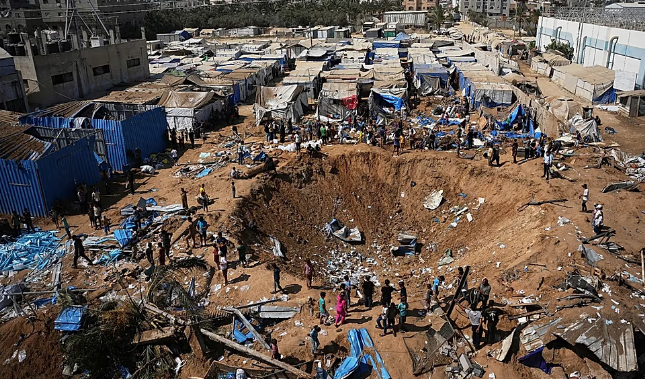
Israel’s military has pledged to continue offensive operations in Gaza, reinforcing the government’s position after Prime Minister Benjamin Netanyahu rejected a US-backed proposal aimed at ending the conflict and securing the disarmament of Hamas.
Chief of the General Staff Lt. Gen. Eyal Zamir made the remarks during an operational visit on Wednesday, where he met senior military commanders and received updates on the situation across Gaza.
According to a statement issued by the Israel Defense Forces (IDF), Zamir said the military had significantly weakened Hamas and changed the security landscape since the start of the conflict. He added that Israeli forces would continue proactive operations to eliminate threats and ensure the safety of Israeli communities.
“In the Gaza Strip, we have struck a blow against Hamas, significantly weakened it and altered the security situation,” Zamir said. “The IDF will continue to operate proactively and in accordance with the principle we have established – to eliminate threats and, in all circumstances, to defend the communities and their residents, and to safeguard their security.”
His comments came a day after Netanyahu publicly stated that Israel had not accepted a draft proposal supported by the United States to end the fighting.
Speaking in a video message, Netanyahu said US President Donald Trump and his team believed Hamas could be persuaded to disarm and demilitarise. He confirmed that Israel had reviewed the proposal but had returned it with its own comments.
“They sent us a draft, we did not agree. It is not our draft,” Netanyahu said, adding that Israel remained committed to protecting its national security interests.
Last week, Trump announced that his Board of Peace had reached what he described as a “historic” agreement calling for the complete disarmament of Hamas and other armed groups in Gaza. Under the proposal, Israeli forces would withdraw from the territory while an International Stabilization Force, working alongside a newly established Palestinian police unit, would oversee security and governance during a political transition.
The proposal has been viewed by some analysts as a possible pathway toward ending nearly three years of conflict, though significant obstacles remain.
Jennifer Gavito, a nonresident senior fellow with the Scowcroft Middle East Security Initiative at the Atlantic Council, said outside mediators would play a central role if any agreement were to succeed.
She said Egypt and Qatar would need to continue exerting pressure on Hamas to fulfil its commitments, while Washington would also have to apply considerable diplomatic pressure on Israel to move the process forward.
The war began after Hamas launched its October 7, 2023, attack on Israel, killing more than 1,200 people and taking 251 hostages into Gaza, according to Israeli figures.
Israel responded with a large-scale military campaign in Gaza. According to Gaza’s health ministry, more than 73,000 people have been killed since the conflict began, while efforts to reach a lasting ceasefire have repeatedly stalled amid disagreements over security, governance and the future of Hamas.
