


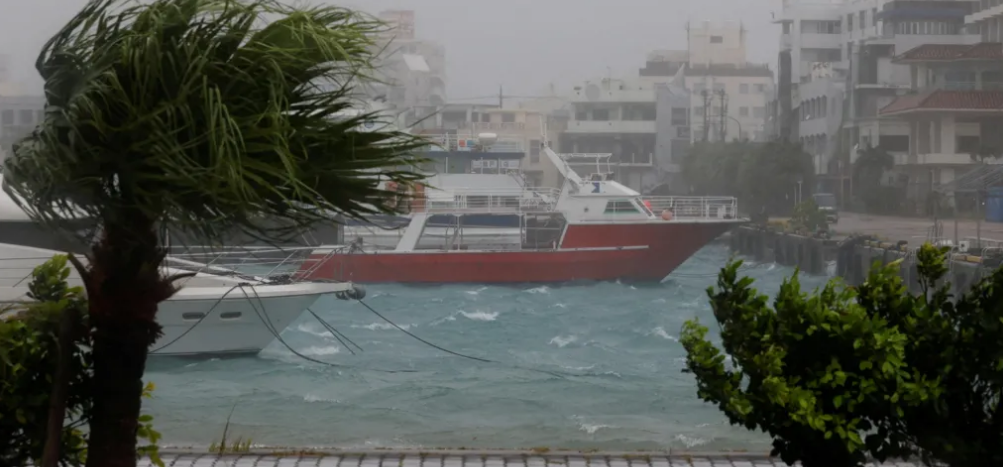
Chinese authorities have evacuated hundreds of thousands of residents from coastal areas as Typhoon Bavi moves toward eastern China, raising fears of severe flooding, landslides and widespread disruption just days after another destructive storm struck the country.
The typhoon, stretching nearly 1,000 kilometres across at its widest point, is expected to make landfall near the city of Wenzhou in Zhejiang province on Sunday morning. Although Bavi has weakened to a Category 1 storm, forecasters warn that its massive rain bands still pose a serious threat due to the large volume of moisture they carry.
Officials said eastern Zhejiang and northeastern Fujian provinces are expected to experience exceptionally heavy rainfall. Authorities ordered large-scale evacuations as a precaution to reduce the risk to lives and property before the storm reaches the coast.
Wenzhou, a major commercial city with a population of around 10 million, lies close to the projected path of the typhoon. Emergency services have been mobilised across the region, while local governments have urged residents to remain indoors and follow official safety instructions.
Before approaching China, Typhoon Bavi swept through parts of the western Pacific. It began as a powerful super typhoon, bringing winds of up to 290 kilometres per hour as it struck Guam and the Northern Mariana Islands earlier in the week.
The storm later weakened but still caused significant disruption after passing over Japan’s Sakishima Islands in the Ryukyu chain. At least five people were injured, and thousands of households experienced power outages as strong winds and heavy rain battered the islands.
Taiwan also felt the effects of the storm as Bavi brushed past its northern coast. While the island avoided a direct landfall, heavy rainfall prompted thousands of residents to evacuate vulnerable areas amid fears of landslides. Authorities had warned that some regions could receive up to one metre of rain during the storm. No deaths have been reported in either Japan or Taiwan.
The typhoon has already proved deadly elsewhere in Asia. In the Philippines, landslides triggered by heavy rainfall killed at least 17 people, highlighting the destructive potential of the storm despite its gradual weakening.
Across the affected region, transportation has been disrupted. Dozens of flights have been cancelled, schools have suspended classes and ferry services have been halted in several locations. Residents have also rushed to supermarkets to stock up on food, drinking water and other essential supplies before the storm arrives.
China’s latest emergency comes as parts of the country’s south continue recovering from the impact of Typhoon Maysak, which struck earlier this week. That storm claimed at least 39 lives, caused extensive agricultural damage by killing large numbers of livestock and even generated two rare tornadoes in Hubei province.
Authorities are continuing to monitor Typhoon Bavi closely as it approaches the Chinese mainland, warning residents to remain alert for further updates and emergency instructions.
