


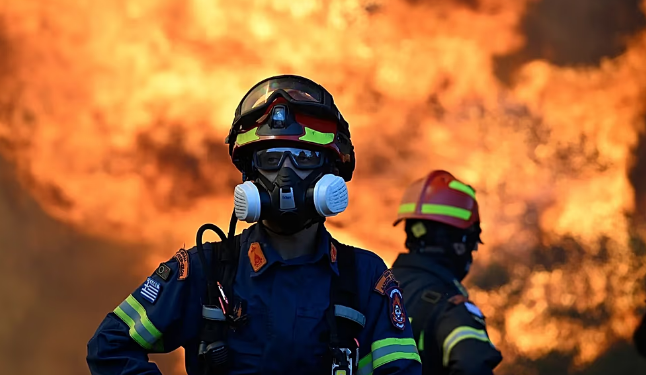
Professional firefighters are becoming increasingly important across Europe as wildfires grow more frequent and severe, with major differences between countries in the size of their firefighting workforces and spending.
Eurostat data show that the European Union had about 372,400 professional firefighters in 2025, equivalent to 0.18 percent of total employment. The figures include forest firefighters but exclude volunteers and do not identify how many professionals specialise specifically in wildfire response.
Germany had the largest professional firefighting workforce, with about 57,700 personnel, followed by France with 47,700 and Italy with 43,500. Poland ranked fourth with around 40,000, while Spain had about 38,500.
Together, Germany, France, Italy and Spain accounted for about 187,400 professional firefighters, representing 50.3 percent of the EU total.
Romania and Greece each employed more than 20,000 professional firefighters, while Portugal and Czechia had more than 16,000 each. Cyprus and Estonia recorded fewer than 2,000. Eurostat data were unavailable for five EU member states.
When firefighter numbers are measured against total employment, Greece had the highest share in the EU at 0.47 percent, followed by Croatia at 0.43 percent. Portugal ranked third at 0.33 percent, well above the EU average.
The four largest economies had lower shares, with Italy at 0.18 percent, Spain at 0.17 percent, France at 0.16 percent and Germany at 0.14 percent.
National staffing is only one part of Europe’s wildfire response. Countries can request additional personnel and equipment from other member states when fires overwhelm domestic resources.
EU Commissioner for Preparedness and Crisis Management Hadja Lahbib said no country should have to face major wildfires alone. Through the EU Civil Protection Mechanism, nations can request firefighters, aircraft, helicopters and other emergency resources.
The 2026 rescEU fleet and European civil protection pool includes 22 firefighting aircraft and five helicopters.
Wildfire activity has already been severe this year. By the 31st week of 2026, about 489,826 hectares had burned across the EU, 13 percent above the average for the same period between 2012 and 2025, according to Our World in Data.
Governments are also spending heavily on fire protection. EU general government expenditure on fire-protection services reached €43.8 billion in 2024, equal to 0.5 percent of total public spending.
Germany spent the most at €13.7 billion, followed by France at €7.9 billion. Greece spent slightly more than €1 billion, representing 0.9 percent of its total government expenditure, the highest proportion in the EU.
Rising temperatures are adding to the pressure. Europe is the world’s fastest-warming continent, while June 2026 was the hottest June on record in Western Europe, according to Copernicus.
With fire risk expanding beyond traditional Mediterranean hotspots into countries such as Germany, Czechia and Sweden, European governments are increasingly relying on both domestic firefighting capacity and coordinated cross-border support.
