


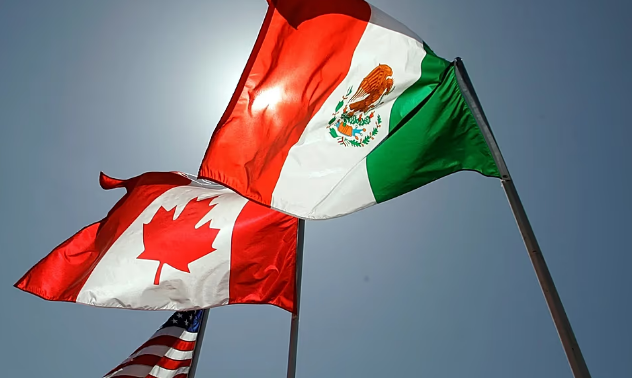
Canada has urged the United States and Mexico to extend the North American free trade agreement for another 16 years, reinforcing the importance of economic stability across the continent even as political friction simmers between Washington and Ottawa.
In a letter sent Tuesday to US Trade Representative Jamieson Greer and Mexico’s Economy Secretary Marcelo Ebrard, Canada said the agreement remains central to regional prosperity. “The Agreement is highly beneficial to each of our countries and to the integrated North American economy,” the letter stated.
The appeal comes ahead of the scheduled July review of the United States-Mexico-Canada Agreement (USMCA), the successor to NAFTA, which has governed trade relations across North America since the early 1990s. Under its current structure, the deal can either be extended for 16 years or shift into a system of annual reviews after 2036.
Mexican officials have also expressed support for a long-term extension. Ebrard said Mexico would favour a 16-year renewal, aligning with Canada’s position. Canadian officials confirmed that similar correspondence had been received from both US and Mexican counterparts.
Dominic LeBlanc, Canada’s minister responsible for US trade, met with US officials in Washington alongside chief trade negotiator Janice Charette. He said discussions included Canadian proposals addressing long-standing US concerns, while also acknowledging differing views on how the agreement should evolve.
US officials have previously indicated interest in tighter oversight of the deal. LeBlanc noted that Washington may prefer more frequent reviews, a position Ottawa views as potentially introducing uncertainty into one of the world’s largest integrated trading relationships.
Under the agreement’s current terms, if no consensus is reached by July 1, the pact would automatically continue for another 10 years, with annual reviews thereafter.
The diplomatic push comes at a sensitive moment politically. US President Donald Trump has recently revived controversial rhetoric suggesting Canada could become the “51st state,” posting the phrase on social media alongside commentary about Canada’s economy. The remarks drew sharp responses from Canadian leaders.
Ontario Premier Doug Ford rejected the idea outright, stating: “Canada will never be the 51st state. Canada is not for sale.”
Prime Minister Mark Carney, while acknowledging economic challenges at home, said Canada must maintain working relations with Washington. He described the United States as both Canada’s largest trading partner and closest security ally, adding that Ottawa would not react to every political statement coming from the US administration.
Carney also noted that Canada currently faces around 30 US trade irritants, compared with nearly 60 involving Mexico, underscoring the complexity of negotiations ahead.
While tensions continue, Washington retains the option to withdraw from the agreement with six months’ notice, adding further pressure to ongoing discussions over the future of North American trade cooperation.
