


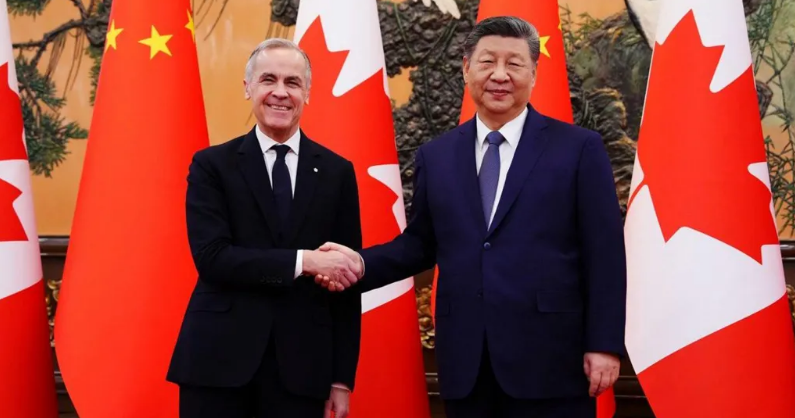
Chinese leader Xi Jinping and Canadian Prime Minister Mark Carney announced a series of tariff reductions on Friday, signaling a significant reset in the two countries’ relationship following Carney’s first visit to Beijing in nearly a decade.
Under the new agreement, China will reduce levies on Canadian canola oil from 85% to 15% by 1 March. In return, Ottawa has agreed to apply the most-favoured-nation tariff of 6.1% on Chinese electric vehicles, with a cap of 49,000 EVs to protect domestic automakers. The deal also includes reduced tariffs on Canadian lobsters, crabs, and peas. Carney described the outcome as a breakthrough, emphasizing the predictability and respectfulness of discussions with Beijing.
“Canada has successfully secured a more predictable trading relationship with China, and the talks were realistic and respectful,” Carney told reporters. He stressed that Ottawa maintained its “red lines” on human rights, election interference, and the need for safeguards, noting that cooperation would be pursued where interests align.
Xi hailed the agreement as a “turnaround” in bilateral relations and framed it as a step toward global stability. “The healthy and stable development of China-Canada relations is conducive to world peace, stability, development, and prosperity,” he said during talks at the Great Hall of the People.
The agreement comes after years of tit-for-tat tariffs that strained economic ties. In 2024, Canada imposed a 100% tariff on Chinese electric vehicles, prompting Beijing to retaliate with duties on over $2 billion of Canadian agricultural products, including canola. By 2025, Chinese imports of Canadian goods had fallen by roughly 10%. The new deal eases this tension while maintaining protections for Canadian industries.
Carney’s visit included meetings with senior executives from Chinese companies in sectors such as electric vehicle batteries and energy, highlighting Ottawa’s intent to diversify trade away from the United States amid uncertainty caused by Washington’s fluctuating tariffs. Analysts view the visit as a modest but realistic reset, balancing trade opportunities with ongoing political differences.
Former Canadian diplomat Colin Robertson noted that while the deal may not be ambitious, it reflects a practical approach to cooperation. “The reset may be modest in ambition, but it is much more realistic about what we can reasonably obtain,” he said.
The visit also served as a reminder of the relationship’s turbulent history. The last Canadian prime minister to visit China, Justin Trudeau, met Xi in 2017 before the arrest of Huawei executive Meng Wanzhou in 2018 and the subsequent detention of Canadian citizens Michael Kovrig and Michael Spavor. Both were released in 2021. Ahead of Carney’s trip, Kovrig cautioned that engagement with China must be disciplined, emphasizing the importance of protecting Canadian citizens still imprisoned in the country.
While Canada and China maintain differing political systems, Carney said direct dialogue remains essential. “We’re very clear about where we cooperate and where we differ. But to have an effective relationship, we have direct conversations,” he said.
The new trade measures are expected to take effect by early March, marking a potential turning point in Canada-China economic and diplomatic ties.
