


President Donald Trump has reaffirmed the role of tariffs in his economic strategy, claiming in a pre-Christmas address that the measures are driving jobs, higher wages, and growth in the United States. While economists remain divided over the direct benefits to Americans, the tariffs are widely recognised as having reshaped the global economy, with effects expected to carry into 2026.
The International Monetary Fund (IMF) said the so-called “tariff shock” is smaller than initially feared, but it still contributed to its downward revision of global growth to 3.1% for 2026, down from a previous forecast of 3.3%. IMF head Kristalina Georgieva described the outlook as “better than we feared, worse than it needs to be,” noting that pre-pandemic growth averaged 3.7% annually.
Maurice Obstfeld of the Peterson Institute for International Economics highlighted that the overall impact has been limited by muted retaliation from most countries. China was one exception, prompting a temporary US rollback of certain tariffs. However, after five rounds of trade talks, the United States and China still maintain higher tariffs and trade restrictions than before Trump began his second term.
Tariffs have raised costs for businesses and increased uncertainty, which can reduce investment and efficiency over time. Obstfeld said some of the damage has been offset by lower interest rates, a weaker dollar, and exemptions within the tariffs themselves. Countries including the UK, Japan, and South Korea have negotiated trade deals that exploit these exemptions, while others are expected to follow in 2026.
Despite these pressures, the US economy remains resilient. Growth between July and September reached 4.3% annually, the fastest pace in two years. Bank of America economist Aditya Bhave said tariffs have contributed roughly 0.3–0.5% to inflation, but the full effects may not yet be felt. Consumer spending, which drives a quarter of the global economy, continues to support US growth.
Global trade continues to expand despite the tensions. UNCTAD reported that trade value grew 7% in 2025, surpassing $35 trillion (£26 trillion). Oil prices are expected to decline around 8% this year to $56 per barrel, according to Goldman Sachs, helped by production in the US and Russia and the partial reopening of the Red Sea shipping route, which had been disrupted by Houthi attacks linked to the Gaza conflict.
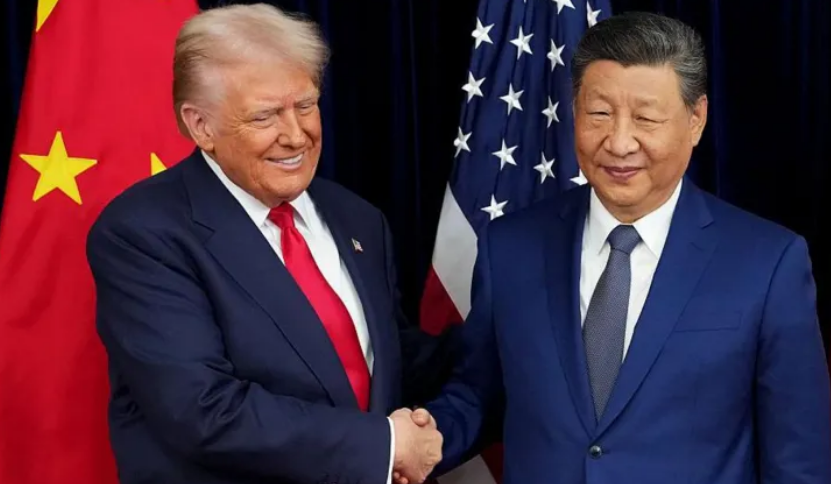
Relations between the US and China remain a key uncertainty. Trade talks will continue when Trump meets President Xi Jinping in April, with rare earth metals, high-end computer chips, and overcapacity in manufacturing among the outstanding issues. Analysts note that while dialogue is critical, expectations for quick resolutions remain low.
In Europe, reliance on inexpensive Chinese imports is growing, prompting the EU to consider stricter controls. In the US, Trump’s trade policy continues to prioritise domestic manufacturing, with the administration arguing that tariffs are necessary to attract new investment in sectors such as automotive, shipping, and pharmaceuticals.
Despite tariffs, Obstfeld said the US economy continues to expand due to strong consumer demand and technological investment, including in artificial intelligence. He predicts tariffs will remain a central topic in policy and debate throughout 2026.
