


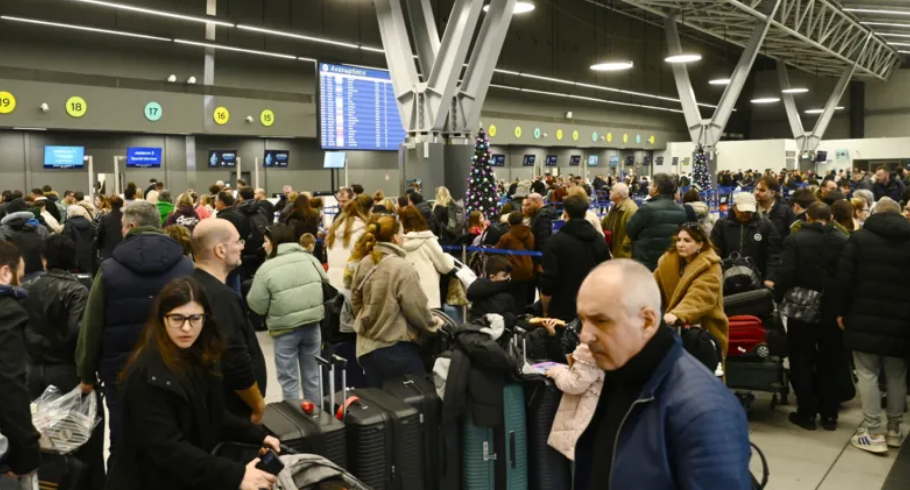
Thousands of passengers were left stranded across Europe on Sunday after Greece temporarily closed its airspace following a major communications failure, leading to widespread flight cancellations and diversions.
The disruption began in the early hours of Sunday, when radio communications used by air traffic controllers were interrupted, forcing authorities to halt all arrivals and departures. Athens International Airport, the country’s busiest hub, was among the worst affected, while Thessaloniki Airport closed completely. Officials are investigating the cause of the outage, with early reports pointing to a possible antenna failure in the Gerania Mountains near Athens.
Panagiotis Psarros, chair of the Association of Greek Air Traffic Controllers, told public broadcaster ERT that “all frequencies were suddenly lost” and that controllers could not communicate with aircraft in the sky. Greek security services are conducting an initial investigation, while Italy, Turkey, and Cyprus have joined efforts to assist in managing the crisis.
Some departures have since resumed, with Athens allowing 35 aircraft an hour to take off, but inbound flights continue to be cancelled or diverted. Passengers from Dublin, Barcelona, and Paris were forced to return to their airports of origin, while flights from Copenhagen and Malta were cancelled entirely. Many other incoming flights have been redirected to Turkey, and disruptions have spread to regional airports including Heraklion in Crete, where three flights, including one to Munich, were delayed.
The timing of the disruption has caused major concerns for travelers hoping to return home before the start of the working week. Passengers have voiced frustration over the lack of information, with many unsure when or if their flights would depart. One traveler at Athens International, speaking to Mega TV, said she was scheduled to work in the United Kingdom on Monday and was unsure how the delay would affect her plans. “Who is going to pay for the additional cost this travel will cost me?” she asked.
Domestic travelers have been offered the option of traveling by train, but journeys would take significantly longer than flights. The disruption comes during a busy period for Greek airports, which typically handle over 600 scheduled flights per day as winter holiday travelers return home.
Officials are working to restore normal operations while ensuring safety. Air traffic control systems across Greece are being carefully tested before full service resumes. Authorities warned passengers to expect delays in both arrivals and departures throughout Sunday and advised travelers to check with their airlines before heading to the airport.
The incident highlights the vulnerability of air traffic systems to technical failures and the challenges in managing major disruptions at key European aviation hubs.
