


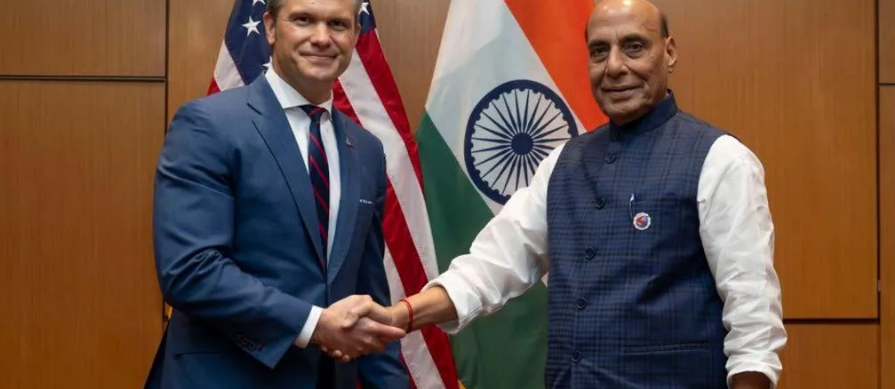
India and the United States have signed a landmark 10-year framework agreement to expand defence cooperation, marking a new phase in their strategic partnership amid ongoing trade negotiations and regional tensions.
The agreement was announced following a meeting between US Defence Secretary Pete Hegseth and Indian Defence Minister Rajnath Singh in Kuala Lumpur on Thursday. According to Hegseth, the pact will strengthen “coordination, information sharing, and technology cooperation” and advance “regional stability and deterrence.”
Indian Defence Minister Singh hailed the agreement as a “signal of growing strategic convergence” between the two democracies. “It will herald a new decade of partnership. Defence will remain a major pillar of our bilateral relations,” he said in a post on X. “Our partnership is critical for ensuring a free, open, and rules-based Indo-Pacific region.”
The framework agreement provides long-term policy direction for the entire spectrum of the India–US defence relationship, encompassing joint military exercises, intelligence sharing, and technology development.
Analysts say the accord was originally scheduled for signing earlier this year but was delayed due to diplomatic tensions. “The deal was meant to conclude in July or August,” said Pramit Pal Chaudhuri of the Eurasia Group. “But India’s irritation at President Trump’s statements about his supposed role in mediating the conflict with Pakistan caused delays.”
The latest pact builds on a series of defence agreements between New Delhi and Washington that have boosted interoperability between their armed forces and opened access to advanced US technology. “This provides further potential in all three areas,” Chaudhuri added.
Defence cooperation featured prominently during Prime Minister Narendra Modi’s visit to Washington in February, when President Trump pledged to expand US military equipment sales to India, including the potential future sale of F-35 stealth fighter jets.
However, ties have been tested by trade disputes and India’s continued purchase of discounted Russian oil and weapons. The Trump administration imposed 50% tariffs on Indian goods and a 25% penalty on oil and arms transactions involving Moscow, straining bilateral relations.
Despite those challenges, India has been steadily reducing its reliance on Russian defence imports while diversifying procurement sources and ramping up domestic production. The US has emerged as an increasingly important partner in this shift, both as a supplier and as a collaborator in technology development.
The defence pact comes as the two nations race to finalise a long-awaited trade agreement by November — one that could restore economic momentum to a relationship now reinforced by deepening military and strategic cooperation.
