


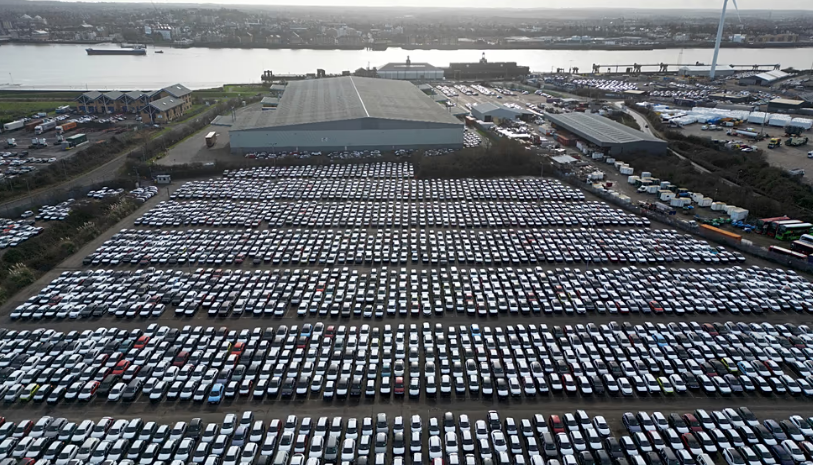
Britain’s automotive industry has suffered its steepest decline in decades after a cyberattack on Jaguar Land Rover (JLR) forced the country’s largest carmaker to halt production, triggering a 35.9% slump in vehicle output in September.
New figures from the Society of Motor Manufacturers and Traders (SMMT) show that UK factories produced just 51,090 cars last month, down 27.1% year-on-year. When including all vehicle types — cars, vans, and commercial vehicles — total production fell by more than a third, marking the lowest September output since 1952.
The sharp drop followed a five-week shutdown at JLR caused by a major cyber incident that paralysed its manufacturing systems. Separate restructuring efforts across the sector further deepened the decline, with commercial vehicle output tumbling nearly 78% — the sixth consecutive monthly fall.
“September’s performance comes as no surprise given the total loss of production at Britain’s biggest automotive employer following a cyber incident,” said Mike Hawes, SMMT’s chief executive. “While the situation has improved, the sector remains under immense pressure.”
Despite the setback, almost half of the vehicles built in September were electrified models, including battery electric, plug-in hybrid, and hybrid cars — signalling the industry’s continued shift towards green technologies. Exports, which account for the majority of UK production, were down 24.5%, with most shipments headed to the EU, the US, Turkey, Japan, and South Korea. Production for the domestic market fell even more sharply, by 34.1%.
The timing of the slump has intensified tensions between the automotive sector and Westminster, just weeks before the government’s Autumn Budget on 26 November. Industry leaders are warning that proposed tax reforms could further damage confidence and put thousands of jobs at risk.
At the centre of the dispute is the government’s plan to scrap Employee Car Ownership Schemes (ECOS), which allow factory workers to buy the cars they help build at reduced tax rates. The change would reclassify these vehicles as company cars — subjecting them to higher tax bands.
According to SMMT estimates, abolishing ECOS could affect 60,000 workers, cut annual new car sales by 80,000 units, and cost the Treasury nearly £500 million in lost tax revenue, while threatening more than 5,000 manufacturing jobs.
Hawes warned that the move undermines the government’s Industrial Strategy, which aims to boost car production to 1.3 million units a year. “Scrapping ECOS puts at risk not just jobs, but the UK’s credibility as a place to build and buy vehicles,” he said.
HM Revenue and Customs (HMRC) defended the proposal, saying: “Private use of a company car is a valuable benefit, and it is right the appropriate tax is paid on it. This measure will ensure fairness, reduce distortions in the tax system, and reinforce incentives for zero-emission vehicles.”
