


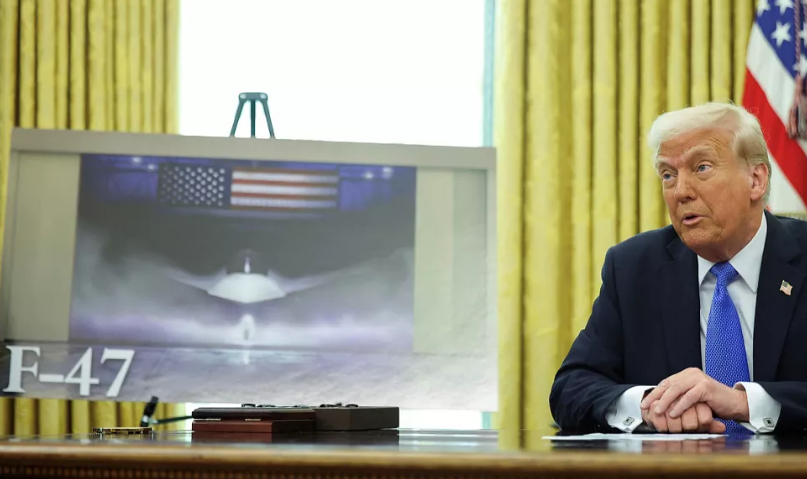
A strike by more than 3,200 Boeing defence workers began Monday, threatening to delay the production schedule of the highly anticipated F-47 fighter jet — a cornerstone of U.S. defence modernisation efforts and a project personally championed by former President Donald Trump.
The walkout, led by the International Association of Machinists and Aerospace Workers (IAM), follows a breakdown in negotiations over a modified four-year labour agreement. Workers at Boeing’s fighter jet production facilities in Missouri and Illinois voted to reject the proposed contract, which included a 20% wage increase, citing concerns over work schedules, pensions, and healthcare benefits.
The F-47 jet, touted by Trump as “the most advanced, most capable, most lethal aircraft ever built,” is seen as pivotal in securing future U.S. air superiority. The aircraft also marks the first time in nearly two decades that Boeing has secured a contract to produce a stealth fighter, breaking Lockheed Martin’s long-standing dominance in the sector.
Some U.S. media outlets have speculated that the aircraft’s name, F-47, may be a symbolic nod to Trump, who would become the 47th U.S. president if re-elected in 2024.
In a statement released early Monday, the IAM said: “3,200 highly-skilled IAM Union members at Boeing went on strike at midnight because enough is enough.” The workers are responsible for assembling advanced defence platforms, including fighter jets and weapons systems critical to U.S. military operations.
Sam Cicinelli, IAM Midwest Territory General Vice President, added: “IAM District 837 members build the aircraft and defence systems that keep our country safe. They deserve nothing less than a contract that keeps their families secure and recognises their unmatched expertise.”
Boeing officials expressed disappointment at the outcome. “We’re disappointed our employees rejected an offer that featured 40% average wage growth and resolved their primary issue on alternative work schedules,” said Dan Gillian, Boeing’s Air Dominance Vice President. He added that the company has activated a contingency plan to minimise disruption.
The strike compounds a turbulent period for Boeing. The company has struggled with repeated crises, including the 737 Max crashes in 2018 and 2019, which killed 346 people, and a more recent Dreamliner crash in June 2025 that left over 260 dead. Boeing’s reputation and commercial output have suffered as a result.
Despite these setbacks, Boeing’s latest quarterly report showed some signs of recovery, with losses narrowing to $611 million compared to $1.44 billion in the same period last year. However, any delay in the F-47 programme could affect not only its defence revenue but also undermine efforts to reposition itself as a leading force in the aerospace industry.
