


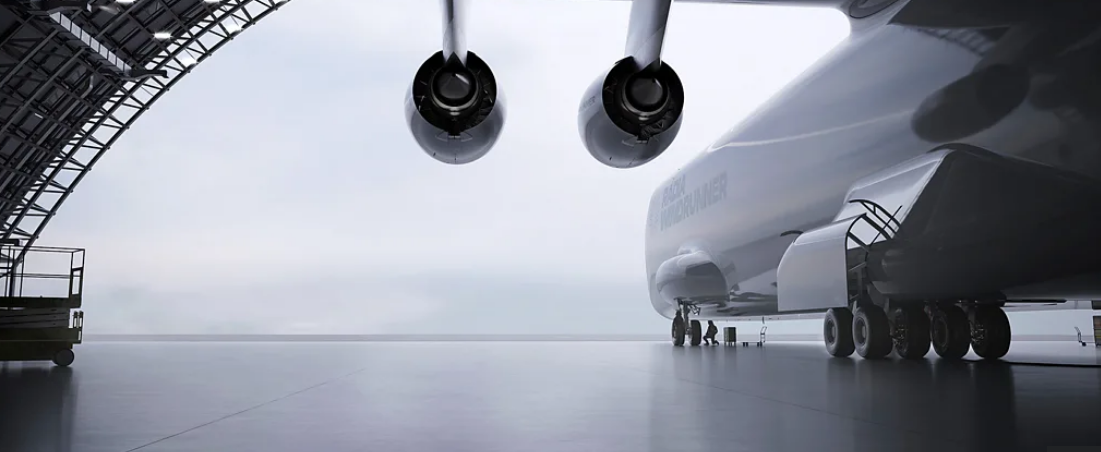
A bold new aerospace project is taking shape in Colorado, aiming to redefine the future of both aviation and renewable energy. Radia, a startup founded by serial entrepreneur and aerospace engineer Mark Lundstrom, has unveiled plans to build the WindRunner — a massive cargo aircraft designed to transport the largest wind turbine blades ever used on land.
Though Radia has never built an aircraft before, it has raised more than $150 million and assembled a team of veteran aerospace partners, including Italy’s Leonardo and Spain’s Aernnova, to bring the ambitious project to life.
The WindRunner, if completed, would become the largest heavier-than-air aircraft ever built. At 108 metres long with an 80-metre wingspan, the aircraft is being engineered to carry turbine blades up to 105 metres in length — components that are currently too large for traditional road or rail transport to reach inland wind farms. Unlike conventional air freighters, WindRunner is being specifically designed to land on semi-prepared 1,800-metre airstrips that can be built near wind farm construction sites.
“The inability to transport massive turbine components is one of the biggest obstacles to scaling onshore wind energy,” said Lundstrom. “The WindRunner is our solution to that bottleneck. By enabling larger turbines on land, we can double or triple the economically viable land area for wind farms in the US alone.”
Radia’s plan is part of a broader vision it calls “GigaWind” — an initiative that could, by 2050, support the deployment of more than one million large onshore wind turbines globally.
However, the project faces several challenges. While Radia has partnered with experienced component suppliers and insists it will rely on existing aerospace technologies, it has yet to publicly announce its engine supplier — a key detail in any aircraft development programme.
Scepticism remains. Aviation expert Chris Pocock questioned the project’s feasibility, noting its lack of transatlantic range and cautioning that alternative technologies, such as hybrid airships, could prove more viable in the long term. “Without deeper investment and a named engine partner, the WindRunner still has many hurdles to clear,” Pocock said.
Despite these concerns, the project has attracted interest from beyond the renewable energy sector. In May, the US Department of Defense signed an agreement with Radia to explore using the WindRunner for military cargo missions — a move the company says complements rather than competes with its clean energy mission.
As traditional heavy-lift aircraft like the Antonov An-225 and Boeing C-17 fade from service, Radia believes the WindRunner could fill a critical gap — not just in aviation, but in the global push for cleaner energy.
