


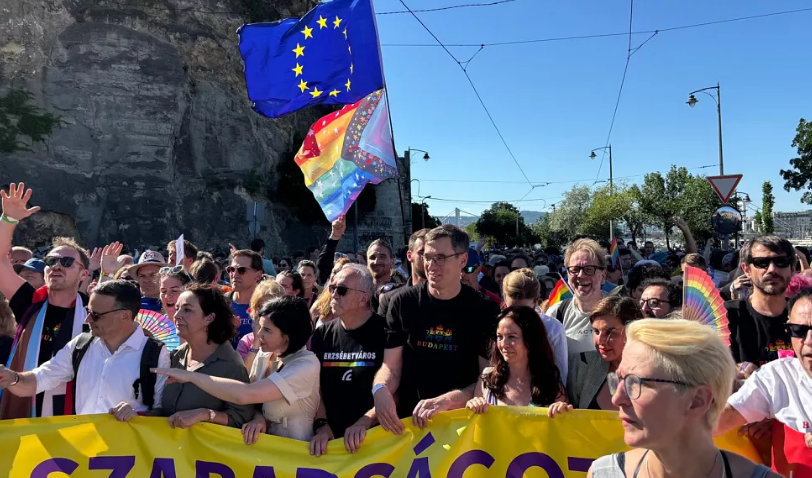
Tens of thousands marched through the streets of the Hungarian capital on Saturday, defying a government-backed ban on LGBTQ+ Pride events, as over 70 Members of the European Parliament and EU Commissioner for Equality Hadja Lahbib travelled to Hungary to show solidarity.
The demonstration, rebranded by Budapest’s city council as a “Day of Freedom” to circumvent restrictive national laws, drew massive crowds waving rainbow and EU flags. Organisers estimated around 200,000 participants, making it one of the largest anti-government mobilisations in recent months.
The MEPs in attendance were mostly from liberal, green, and left-leaning groups including Renew Europe, Socialists & Democrats, the Greens, and The Left. Only one member of the centre-right European People’s Party (EPP), Ireland’s Maria Walsh, participated.
“For me, Pride is not political. It’s about one human being showing up for another,” Walsh told Euronews. “It’s disappointing more EPP colleagues didn’t attend. This was an important mobilisation.”
Notably absent was Peter Magyar, Hungarian MEP and opposition leader of the rising Tisza party, who avoided taking a public stance. Despite leading the polls ahead of the 2026 elections, Magyar’s silence reflects the politically charged atmosphere, with surveys showing nearly half of Hungarians oppose Pride events.
Earlier in the day, Magyar urged restraint. “If anyone comes to harm today, Viktor Orbán alone will be responsible,” he posted on social media.
The Pride ban stems from a controversial March law passed by Hungary’s parliament, citing “child protection” as justification for prohibiting LGBTQ+ content in public spaces. The European Commission has referred the law to the European Court of Justice, citing violations of EU rights and freedoms.
While Commissioner Lahbib met civil society groups in Budapest on Friday, she did not attend the march itself. The city’s Green Party mayor, Gergely Karácsony, enabled the event to proceed by classifying it as a city-organised celebration, bypassing national restrictions.
Heavy security monitored the event, including police surveillance and facial recognition technology. Marchers were warned they could face €500 fines or up to a year in prison. No major incidents were reported by evening, though anti-LGBTQ+ groups staged counter-demonstrations nearby. One far-right protester attempted to block the parade’s lead vehicle before being removed by police.
Despite the risks, many in attendance emphasised the broader message.
“This isn’t just about Pride — it’s about freedom,” said one participant. “Banning Pride in an EU country like Hungary is unacceptable.”
The European Commission continues to review Hungary’s compliance with EU law amid ongoing concerns over democratic backsliding and civil liberties.
