


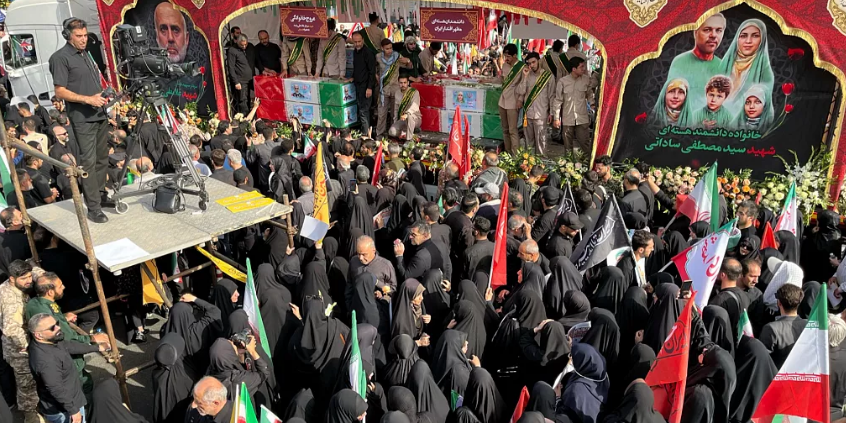
Hundreds of thousands of mourners filled the streets of Tehran on Saturday for a state funeral honoring top Iranian military leaders and nuclear scientists killed during the recent 12-day conflict with Israel. Among those buried were Islamic Revolutionary Guard Corps (IRGC) Chief General Hossein Salami and General Amir Ali Hajizadeh, both of whom were killed on the first day of the fighting.
The funeral procession moved solemnly through Azadi Street, with coffins draped in Iranian flags and adorned with large portraits of the deceased. State media reported that the ceremonies honored 60 individuals, including four women and four children. While official reports claimed more than one million people were in attendance, independent confirmation of that number was not immediately available.
Chants of “Death to America” and “Death to Israel” echoed through the capital as mourners waved Iranian flags and lined the streets in a powerful show of national grief and defiance. Iran’s Supreme Leader Ayatollah Ali Khamenei was notably absent, though Foreign Minister Abbas Araghchi and several senior military figures were present to pay their respects.
The IRGC, founded after the 1979 Islamic Revolution, has grown from a domestic security force into one of Iran’s most powerful institutions, overseeing the country’s ballistic missile program and playing a key role in regional military affairs.
The deadly conflict began on June 13, when Israel launched airstrikes targeting what it described as critical components of Iran’s nuclear infrastructure and military capabilities. General Salami and General Hajizadeh were reportedly among the first casualties. Israel justified the operation by claiming it was a preemptive move to halt Iran’s alleged efforts to develop nuclear weapons — a charge Iran denies, insisting its nuclear program is strictly for civilian use.
Tensions escalated further last week after the United States entered the fray, bombing three nuclear-related sites in Iran. A U.S.-brokered ceasefire was declared on Tuesday, bringing a temporary halt to hostilities, but the situation remains fragile.
Saturday’s funeral not only marked a day of mourning but also served as a symbol of national unity and resistance, as Iran vowed to continue its policies despite international pressure and regional tensions. The large public turnout underscored the deep impact of the conflict on the Iranian populace and the enduring volatility in relations between Iran, Israel, and the West.
