


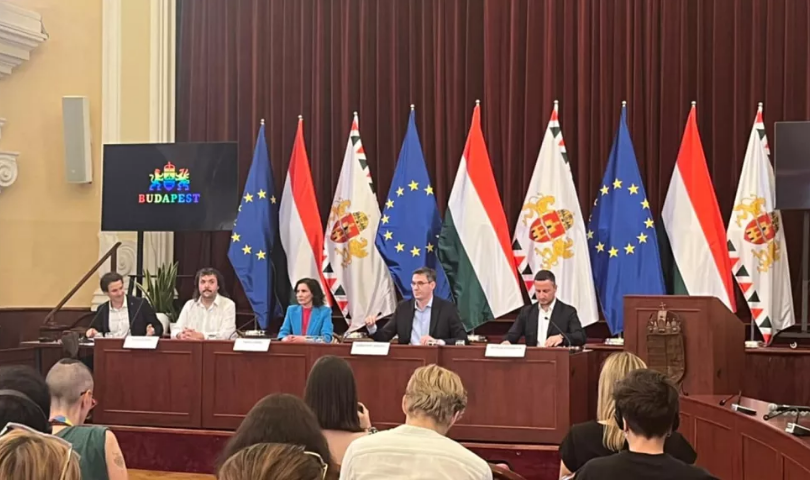
European Union commissioners, senior officials, and more than 70 Members of the European Parliament (MEPs) gathered in the Hungarian capital this weekend in a strong show of support for the Budapest Pride march, despite a controversial ban imposed by national authorities.
The event, now rebranded as Budapest Pride Freedom Day, is being organized by the city municipality and the Rainbow Mission Foundation in defiance of a police decision to prohibit the traditional parade under Hungary’s Child Protection Act. City leaders and international supporters argue that the ban is unlawful and politically motivated.
At a press conference on Friday, Budapest Mayor Gergely Karácsony declared that the march would proceed as a municipal event, which, under Hungarian law, does not require official permission. “Love cannot be banned, no one can be a second-class citizen in Hungary,” Karácsony said, calling Pride a symbol of democratic resistance in a country he described as a “laboratory for dismantling democracy.”
Dozens of EU officials stood beside the mayor, including Hadja Lahbib, EU Commissioner for Equality, who condemned what she called discriminatory treatment of LGBTQ+ individuals under Hungarian law. “It is not acceptable to think that members of the LGBT community are subject to different rules than other people,” she said. “Diversity must be protected.”
Nicolae Ștefănuță, Vice-President of the European Parliament, delivered a message on behalf of EP President Roberta Metsola, affirming that over 200 EU delegates would join the march — the largest human rights delegation ever sent by the institution. “If 50,000 people want to take part in a peaceful event, they have the right to do so, and this must be guaranteed in Hungary,” Ștefănuță said.
Pride organisers, led by spokesman Máté Hegedűs, noted that the 2025 march marks the 30th anniversary of Budapest Pride. This year’s theme, “We Are at Home,” sends a clear message: the LGBTQ+ community belongs in Hungary and is not a foreign import.
Despite concerns over far-right counter-demonstrations, including rallies by the Our Homeland Movement and the 64 Counties Youth Movement — both granted police permits — Mayor Karácsony said the city is taking steps to ensure participants’ safety. Hundreds of municipal security officers and private guards will be deployed on Saturday.
The Pride ban has sparked wider outrage across the EU. Commission President Ursula von der Leyen urged Hungarian authorities to ensure the event proceeds “without fear” or reprisals. In contrast, Prime Minister Viktor Orbán accused von der Leyen of treating Hungary like a “subordinate country.”
The growing confrontation underscores broader tensions between Brussels and Budapest over human rights, the rule of law, and democratic freedoms. As Pride goes ahead in defiance of the ban, its message resounds far beyond Hungary’s borders — calling on Europe to defend the rights of all its citizen
