


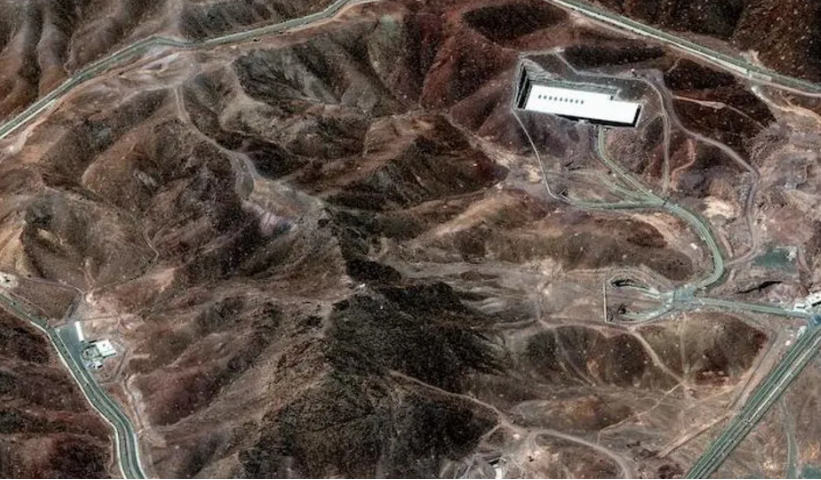
The United States has launched a series of high-impact airstrikes on three of Iran’s key nuclear sites, using its most powerful non-nuclear weapon, the GBU-57 Massive Ordnance Penetrator (MOP), in a dramatic escalation of regional tensions. The bombings mark a major shift in the Israel-Iran conflict, drawing Washington directly into military action against Tehran.
Among the targets was the heavily fortified Fordo uranium enrichment facility, buried deep beneath a mountainside south of Tehran. The site is considered crucial to Iran’s nuclear program and is believed to be one of the most secure underground installations in the world. The MOP, a 13,000kg (30,000lb) precision-guided weapon capable of penetrating 60 feet of concrete or 200 feet of earth, was reportedly used in the operation.
The US also targeted nuclear infrastructure at Natanz and Isfahan. While the full extent of the damage is still unclear, Iran’s Atomic Energy Organization condemned the strikes as a “barbaric violation of international law.” Tehran claims it had already evacuated the facilities before the attacks, minimizing potential casualties and material losses. No rise in radiation levels has been reported by the UN nuclear watchdog or Saudi authorities.
President Donald Trump, flanked by Vice President JD Vance, Defense Secretary Pete Hegseth, and Secretary of State Marco Rubio, declared the mission a success in a televised address. “The nuclear enrichment facilities have been completely and totally obliterated,” he said, warning Tehran that future attacks would be “far greater” unless it returned to diplomatic talks.
Iran, however, has promised retaliation. Foreign Minister Abbas Araghchi warned of “everlasting consequences,” vowing that Iran is reserving “all options” to defend its sovereignty. In response to the US strikes, Tehran launched a fresh wave of missile attacks on Israeli cities including Tel Aviv and Jerusalem.
Security analysts believe Iran may retaliate by targeting US military bases across the Middle East—particularly in Bahrain, Iraq, and Qatar—or by disrupting shipping through the Strait of Hormuz, a critical global energy route. Other options include swarm attacks on US naval forces using drones or fast boats.
Domestically, the strikes have sparked sharp political debate. While Republican lawmakers praised the action, Democrats and independents expressed deep concern over the legality and implications of the escalation. Senate Democrat Hakeem Jeffries warned of a “disastrous war,” while Senator Bernie Sanders called the strikes “grossly unconstitutional,” arguing that Trump bypassed Congress.
The confrontation follows Israel’s surprise June 13 attacks on Iranian nuclear and military targets, which triggered a wave of missile exchanges. Trump had previously warned Iran to return to nuclear negotiations within two weeks—a deadline that was abruptly shortened with Friday’s strikes.
With Iran’s advanced missile arsenal still largely intact, experts warn the crisis may just be entering its most dangerous phase.
