


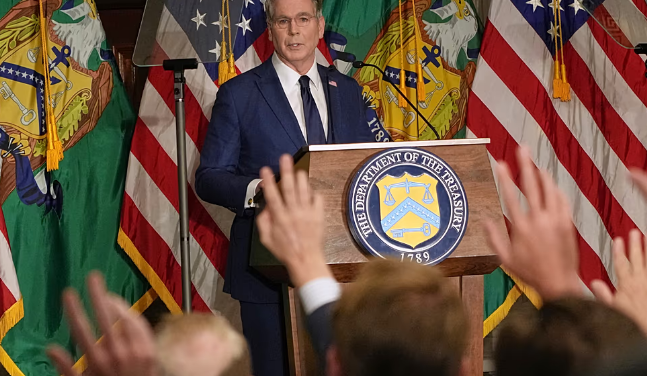
The United States has expanded sanctions aimed at cutting Iran off from the global financial system, warning companies around the world that continuing to do business with Tehran could put their access to the US dollar at risk.
US Treasury Secretary Scott Bessent described the campaign as an “economic onslaught” against Iran’s remaining financial connections. He also said he expected a major financial institution to be sanctioned before the end of the week.
The latest measures, described by Washington as Operation Economic Outcast, target almost 60 companies, individuals and vessels across several countries. Chinese nationals are among those affected. The Treasury has also withdrawn licences that previously allowed limited transactions involving Iran.
The new approach expands the threat of secondary sanctions beyond Iran’s oil industry. Shipping, aviation, gold, technology and digital assets are now among the sectors facing greater scrutiny.
Bessent said companies that help move money for Iran could be excluded from the US dollar system. When asked whether China could be targeted, he said no entity would be exempt from the measures.
Washington has not imposed penalties directly on a third country under the latest measures, instead giving companies time to adjust their activities. Bessent did not provide a specific deadline but warned that the United States would not wait indefinitely.
President Donald Trump has also been contacting foreign leaders as Washington seeks to persuade them to reduce or end commercial ties with Iran.
Iran has promised to respond and said it expects major trading partners to resist US pressure.
For European companies, direct exposure to Iran remains relatively small. European Union trade in goods with Iran was worth about €3.72 billion in 2025, with EU exports accounting for €2.97 billion. That represented around 0.1% of the bloc’s total exports, a sharp decline from more than €27 billion in trade recorded in 2011.
Germany accounted for about 32% of EU-Iran trade, followed by Italy with 16% and the Netherlands with 15%. European exports to Iran mainly include pharmaceuticals, machinery and medical equipment, while imports are largely food products such as pistachios.
European financial markets showed little immediate reaction to the announcement, with major indexes trading modestly higher on Tuesday.
The larger concern for European businesses is the effect of US sanctions on international banking and trade networks. Banks, insurers, shipping firms and commodity traders can face penalties because of transactions involving sanctioned entities, even when their own operations are outside Iran.
European companies remember the case of BNP Paribas, which paid $8.9 billion in 2014 after processing transactions involving Iran, Sudan and Cuba.
The latest US measures are therefore likely to force international businesses to weigh their limited Iranian trade against the much larger importance of maintaining access to the US financial system.
