


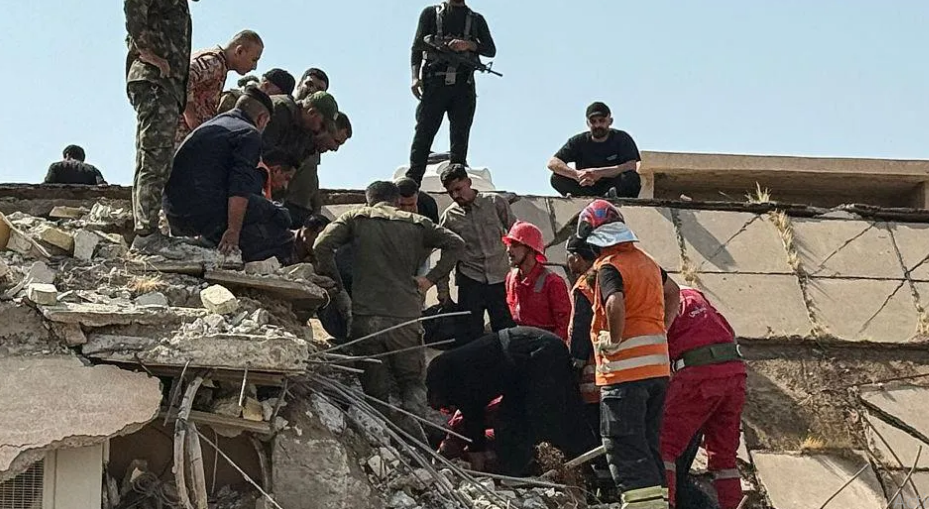
The United States and Saudi Arabia carried out coordinated airstrikes against Iran-backed militias in Iraq, marking a sharp escalation in regional tensions after the US military said it intercepted Iranian missiles targeting American forces in the Middle East.
US Central Command (Centcom) said the strikes targeted “Iran-aligned terrorists” directed by Iran’s Islamic Revolutionary Guard Corps (IRGC) to attack US personnel and Saudi energy infrastructure.
The operation came hours after Centcom reported that Iran launched missiles toward US forces at 5:45 p.m. EDT on Tuesday. The US military said all incoming missiles were successfully intercepted, preventing casualties or damage.
Iran’s IRGC said the missiles were aimed at a US air base and a command center in Jordan, describing the attack as retaliation for what it called American aggression. The IRGC also claimed its naval forces targeted three oil tankers in the Strait of Hormuz after accusing them of sailing through what it described as an unsafe route.
Centcom said US and Saudi fighter aircraft struck multiple logistics and weapons sites in eastern Iraq in response to more than 30 drone attacks carried out over the previous 72 hours by groups it said were backed by the IRGC. According to the US military, the drone attacks failed to achieve their objectives.
“The IRGC and its terrorist proxies must cease these attacks to avoid further US military response,” Centcom said in a statement.
Saudi Arabia also confirmed its participation in the operation. Defense Ministry spokesman Major General Turki al-Maliki accused Iran-backed militias operating from Iraqi territory of launching drones toward oil facilities in the kingdom’s Eastern Province and the Riyadh region earlier this week.
He said Saudi Arabia acted under its right to self-defense by carrying out strikes against specific militia targets.
“The Kingdom of Saudi Arabia reiterates that it does not seek escalation but will respond decisively to any aggression directed against it,” al-Maliki said.
Iraq’s Popular Mobilisation Forces (PMF), an umbrella organization made up largely of Shiite militias integrated into Iraq’s armed forces, said at least 20 of its members were killed and 32 others wounded in the strikes.
The PMF said bases in Baghdad, Wasit, Nineveh, Basra, Kirkuk, Karbala and Diyala provinces were hit. An official told AFP that attacks in Nineveh and Diyala caused the highest number of casualties.
The organization condemned the airstrikes, calling them a serious violation of Iraq’s sovereignty and an attack on official security institutions.
Iran denied involvement in the drone attacks on Saudi Arabia. A defense official quoted by Iranian state television said blaming Tehran for attacks on US interests in the region was a “major miscalculation.”
The renewed fighting comes just days after US President Donald Trump spoke of “very friendly negotiations” over the Strait of Hormuz, following a brief pause in hostilities. That lull ended after weeks of military exchanges between the United States and Iran, including US strikes on Iranian military facilities and retaliatory missile and drone attacks against American positions in neighboring countries.
Concerns over the latest escalation pushed oil prices higher. Brent crude rose more than 4 percent to $87.70 a barrel during Asian trading, while US West Texas Intermediate climbed 4.2 percent to $82.62 as investors worried about potential disruptions to energy shipments through the Strait of Hormuz, a key global oil transit route.
The latest developments coincided with Israeli Prime Minister Benjamin Netanyahu’s visit to Washington, where he met President Trump at the White House. Pentagon data also showed that at least 624 US service members have been wounded since military operations against Iran began in February, with 417 injuries linked to Operation Epic Fury, the joint US-Israeli campaign targeting Iranian military assets.
