


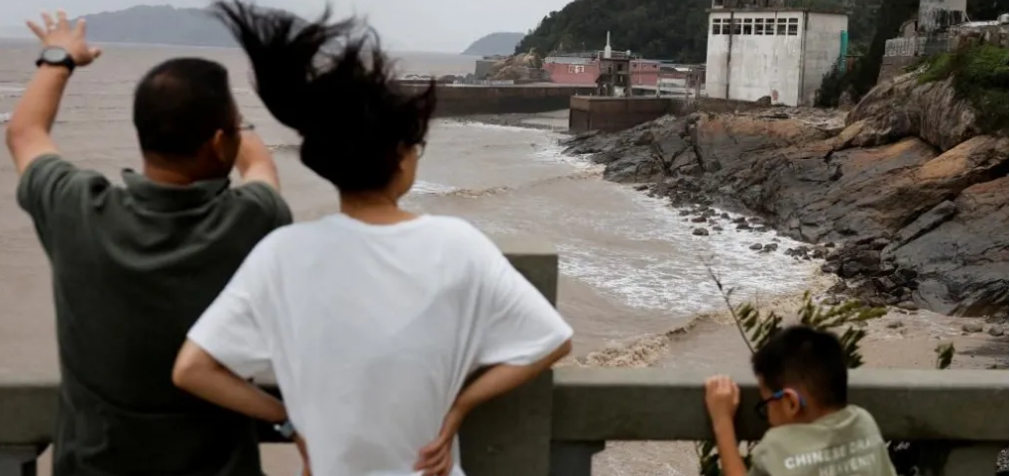
Nearly two million people have been evacuated from eastern China after Typhoon Bavi made landfall, marking the second major storm to strike the country within a week and prompting widespread transport disruptions and emergency measures.
The storm first came ashore in the coastal city of Taizhou on Saturday evening before making a second landfall near Wenzhou around midnight. Although Bavi has weakened from a typhoon to a severe tropical storm, forecasters warned that the system still carries enormous amounts of moisture capable of producing dangerous rainfall and flooding.
Chinese state media reported that the centre of the storm reached Hangzhou in Zhejiang province on Sunday morning and is expected to move into eastern Anhui on Monday before heading toward the northern Yellow Sea from the Shandong Peninsula on Tuesday.
Authorities evacuated more than 1.7 million residents from Zhejiang province, while thousands more left their homes in neighboring regions as emergency preparations intensified. Schools, workplaces and outdoor activities were suspended across Zhejiang, with around 400 flights and dozens of train services cancelled due to the severe weather.
In Wenzhou, a city of about 10 million people located along the storm’s path, hundreds of thousands of residents were moved to safer locations. Local resident Li Liangxing told Reuters that strong winds brought down roof tiles and tree branches, adding that the situation had left many people frightened.
Officials also ordered the evacuation of about 100,000 people in Beijing as a precaution against potential weather-related risks.
Bavi initially developed into a super typhoon over the Pacific Ocean, producing winds of up to 290 kilometers per hour as it struck Guam and the Northern Mariana Islands earlier in the week. The system later weakened while crossing the Pacific before hitting Japan’s Sakishima Islands, where at least five people were injured and thousands lost electricity.
The storm also brushed northern Taiwan, bringing torrential rain and raising concerns about landslides. Thousands of residents evacuated vulnerable areas, although the island avoided a direct strike and no deaths have been reported. Authorities had warned that rainfall could reach as much as one meter in some locations. Schools closed, dozens of flights were cancelled and residents stocked up on food and essential supplies ahead of the storm.
The Philippines suffered the deadliest impact earlier in the week when landslides triggered by Bavi killed at least 17 people.
China’s latest weather emergency comes as southern parts of the country continue recovering from Typhoon Maysak, which struck days earlier. That storm claimed at least 39 lives, caused extensive agricultural damage through livestock losses and triggered two rare tornadoes in Hubei province.
Emergency services remain on high alert as Bavi continues moving inland, with authorities warning residents to stay away from flood-prone areas and follow official safety instructions until the storm weakens further.
