


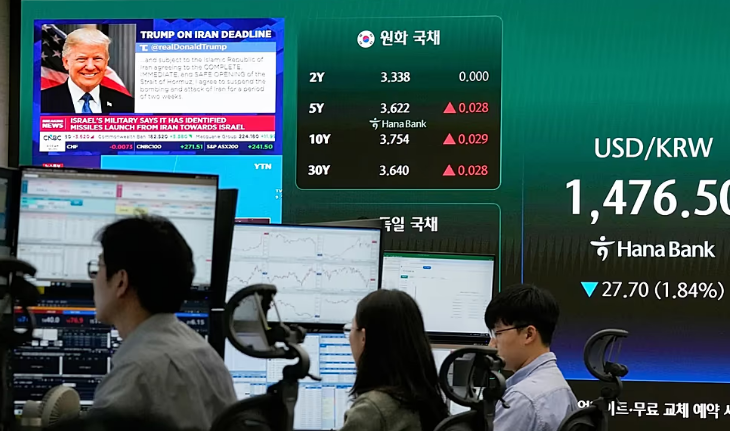
Oil prices fell sharply on Wednesday as the United States and Iran agreed to a two-week ceasefire, including the reopening of the Strait of Hormuz, a key shipping lane for global energy supplies. Brent crude dropped to around $95 per barrel, while West Texas Intermediate (WTI) settled near $96 per barrel, reversing some of the dramatic gains seen since the outbreak of hostilities in late February.
The decline came after US President Donald Trump announced he was holding off on planned strikes against Iranian bridges, power plants, and other civilian infrastructure. Iran confirmed that the Strait of Hormuz would be open to shipping under its military supervision for the duration of the truce, allowing vessels to transit the narrow waterway that handles roughly one-fifth of the world’s oil exports.
Although prices have fallen, both benchmarks remain elevated compared with pre-war levels. Brent is up nearly 30% and WTI more than 40% since February. Wholesale gasoline prices in the United States stand at $2.94 per gallon, reflecting ongoing pressure on global fuel markets despite the temporary easing of geopolitical risk.
Global stock markets responded positively to the news. In Asia, Japan’s Nikkei 225 rose 5.0% in early trading, South Korea’s Kospi jumped 5.9%, and Hong Kong’s Hang Seng increased 2.6%. European indices also surged, with the Euro Stoxx 50 climbing more than 3% and the broader Stoxx 600 up over 4%, eyeing its largest daily gain since April 2025. London’s FTSE 100 rose nearly 2%, Germany’s DAX 30 gained around 1%, while France’s CAC 40 and Italy’s FTSE MIB both advanced more than 3%.
US futures tracked the global optimism, with Nasdaq futures leading gains at roughly 3.2%, while other indices rose between 2% and 3%. Earlier in the session, equities had dipped amid lingering uncertainty before recovering following Pakistani Prime Minister Shehbaz Sharif’s intervention, urging Trump to extend his deadline and calling on Iran to reopen the strait.
Despite the ceasefire, the situation remains fragile. Attacks were still reported in Israel, Iran, and across the Gulf region early Wednesday, and neither Washington nor Tehran has specified the formal start time of the truce. Analysts caution that the risk of prolonged disruptions to Gulf oil flows remains, which could sustain elevated energy prices and feed into global inflation even if hostilities pause temporarily.
Traders are monitoring developments closely, noting that markets are reacting to optimism while remaining wary of any escalation. The ceasefire and reopening of the Strait of Hormuz have eased immediate fears, but the potential for renewed conflict continues to influence oil prices and global financial markets.
