


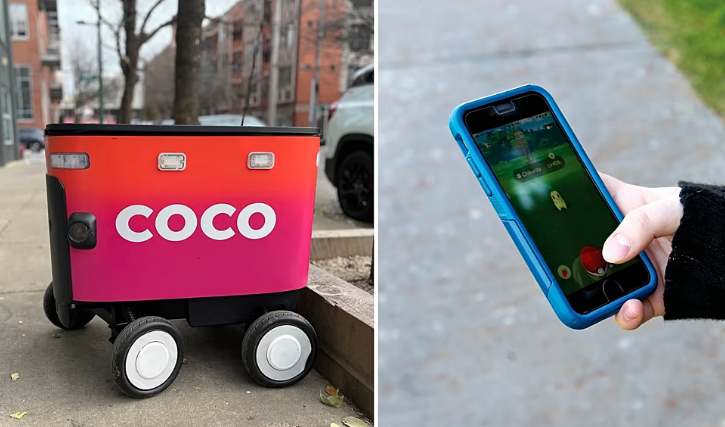
A massive database built by players of Pokémon Go is now being used by Coco Robotics to help its street delivery robots better navigate busy urban environments.
Players chasing virtual characters such as Snorlax or Pikachu may have been doing more than completing in-game challenges. Since the game’s launch in 2016, it has collected more than 30 billion real-world images as users explored streets, parks and landmarks with their smartphones. That data is now being repurposed to improve real-world navigation technology.
The system has been developed by Niantic through its spatial technology division. Known as a Visual Positioning System (VPS), it allows devices to determine their precise location by analysing visual features in the environment rather than relying solely on satellite signals. This approach is particularly useful in dense cities or indoor settings where GPS accuracy can be limited.
Niantic’s VPS has recently been integrated into Coco Robotics’ delivery network, which operates small wheeled robots in cities including Los Angeles, Chicago and Helsinki. By combining VPS with traditional GPS, the robots are expected to navigate complex urban spaces more safely and efficiently.
Coco Robotics currently runs a fleet of around 1,000 delivery robots, capable of transporting groceries and takeaway orders. The company says it has already completed approximately 500,000 deliveries, with demand for automated last-mile delivery continuing to grow.
Niantic Spatial chief executive John Hanke said navigating real-world environments remains a significant challenge for robotics. He noted that the same technology used to place digital characters accurately within a player’s surroundings can also guide machines through crowded streets.
Coco Robotics co-founder Zach Rash said the partnership would enhance the company’s ability to localise its robots, improving both efficiency and reliability. He added that access to advanced positioning systems would help address the challenges of operating in unpredictable city conditions.
Much of the data used to train the system comes from optional in-game features such as “Field Research,” which encourage players to scan public spaces, statues and landmarks in exchange for rewards. These contributions have helped refine the accuracy of the VPS technology over time.
Niantic has said that participation in such features has always been voluntary, with users required to opt in. The company has also maintained that it is transparent about how data is collected and used.
The collaboration highlights how data generated through gaming can find practical applications beyond entertainment, supporting advances in robotics and urban mobility.
