


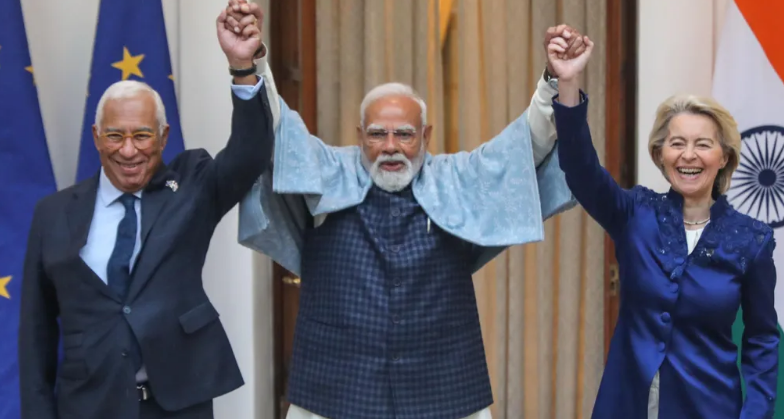
India and the European Union have reached a landmark trade agreement, ending almost 20 years of on-and-off negotiations. The deal, described by European Commission President Ursula von der Leyen as the “mother of all deals,” aims to strengthen economic and strategic ties between the two partners amid growing global trade tensions. Indian Prime Minister Narendra Modi called the agreement “historic,” noting its potential to boost manufacturing, services, and agricultural sectors.
The pact covers a market of two billion people and nearly 25% of global gross domestic product. It will eliminate tariffs on a wide range of goods, including chemicals, machinery, electrical equipment, aircraft, and spacecraft, through phased reductions. Duties on motor vehicles, currently as high as 110%, are set to fall to 10% under a quota of 250,000 units, a significant increase from the 37,000 units India allowed under its deal with the UK last year.
European exports of wine, beer, and olive oil will also see reduced tariffs, while Indian exports such as textiles, leather, marine products, handicrafts, gems, and jewellery will gain preferential access to EU markets. Sensitive domestic sectors in India, including dairy, cereals, poultry, soy meal, and certain fruits and vegetables, will remain protected.
The agreement includes a mobility framework that eases short-term travel restrictions for professionals between India and the EU. “It will make access to European markets easier for India’s farmers and small businesses,” Modi said. “It will boost innovative partnerships.”
The deal arrives amid economic and geopolitical pressure from the United States. India faces 50% tariffs imposed by Washington last year, while the EU has also been subject to US threats over trade disputes. Von der Leyen framed the agreement as a demonstration that cooperation is a stronger response to global challenges than tariffs or coercion. European Council President António Costa said the deal sends a message that trade agreements are preferable to punitive measures.
Experts say labour-intensive sectors in India, such as shrimp farming, textiles, and gems and jewellery, are likely to benefit from the pact, which could offset the impact of US tariffs. Challenges remain, particularly regarding compliance with EU standards on environmental and carbon regulations. Economist Mitali Nikore said India’s manufacturing sector may need to adapt to meet these requirements.
For the EU, Germany and France are expected to gain the most from the agreement, which provides market access to one of the world’s fastest-growing economies. Analysts describe the deal as a foundation for deeper economic relations rather than a final endpoint.
Formal ratification will occur later this year, following approval by the European Parliament and member states. Alongside trade, India and the EU are advancing security and defence cooperation, including maritime security, cyber threats, and joint supply-chain development.
Bilateral trade reached $136 billion (£99.4 billion) in 2024–25, nearly doubling over a decade. Talks for the deal began in 2007, stalled in 2013, and resumed in 2022. Recent US trade pressures accelerated the agreement, while India has also finalized deals with the UK, Oman, New Zealand, and Australia in recent years.
