


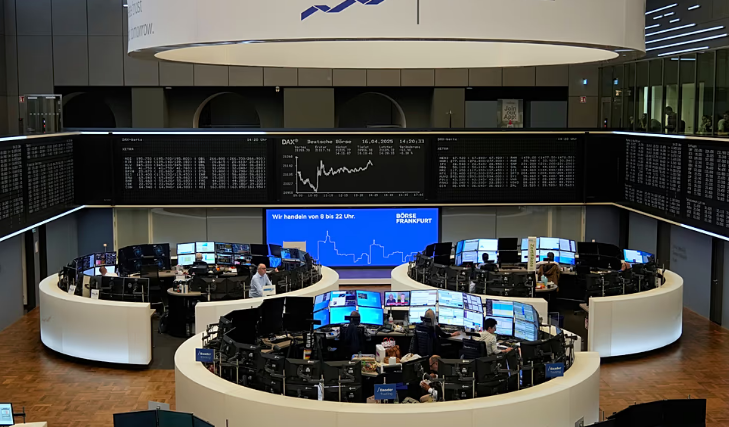
European markets opened lower on Monday following threats from US President Donald Trump to impose tariffs on eight European countries unless they support his plans to acquire Greenland, a semi-autonomous Danish territory.
At around 10 a.m. CET, France’s CAC 40 had dropped 1.28%, Germany’s DAX fell 1.02%, and the UK’s FTSE 100 declined 0.27%. Spain’s IBEX 35 slipped 0.59%, and Italy’s FTSE MIB fell 1.43%, while the broader STOXX 600 index lost 0.87%.
Washington announced on Saturday that Denmark, Norway, Sweden, France, Germany, the UK, the Netherlands, and Finland would face a 10% tariff on US imports starting 1 February if they did not support the Greenland proposal. The rate is set to rise to 25% in June if no agreement is reached.
European leaders are meeting this week to determine their response, reaffirming support for Greenland’s right to self-determination and Denmark’s sovereignty. Options under consideration include retaliatory tariffs on €93 billion of US goods, a measure discussed during last year’s trade tensions, and the activation of the EU’s anti-coercion tool, which allows punitive economic measures against countries attempting to force policy changes.
Shares in European carmakers experienced sharp declines. The STOXX Europe 600 Automobiles & Parts Index dropped over 2% to a 52-week low, with BMW down 4.10%, Volkswagen 3.43%, and Volvo 2.21% just after 10 a.m. CET. Europe’s luxury goods sector also suffered, with the STOXX Europe Luxury 10 index losing almost 3%.
Investors sought safe-haven assets amid market uncertainty. Gold climbed 1.66% to nearly $4,700 an ounce, while silver rose past $94. Defence stocks, however, posted gains, with the STOXX Europe Aerospace & Defence Index up 0.49%. Thales rose 2.41%, Rheinmetall 2.89%, Leonardo 3.05%, and BAE Systems 1.77%.
Markets in Asia were mixed, with Japan’s Nikkei 225 down 0.65%, Hong Kong’s Hang Seng falling 1.05%, and Australia’s S&P/ASX 200 slipping 0.33%. South Korea’s Kospi and China’s SSE Composite Index closed higher. US markets were closed for the Martin Luther King holiday, though S&P futures fell around 1.18%, and the dollar weakened 0.21% against the euro.
Analysts at ING said the Greenland-related tensions are unwelcome for European industry, which had seen improving industrial sentiment. They added that the situation could encourage Europe to boost domestic demand and advance initiatives like the Savings and Investment Union to make European capital markets more competitive.
Markets will also be monitoring announcements from the World Economic Forum in Davos, Switzerland, which begins this week. President Trump is scheduled to address the forum on Wednesday.
