


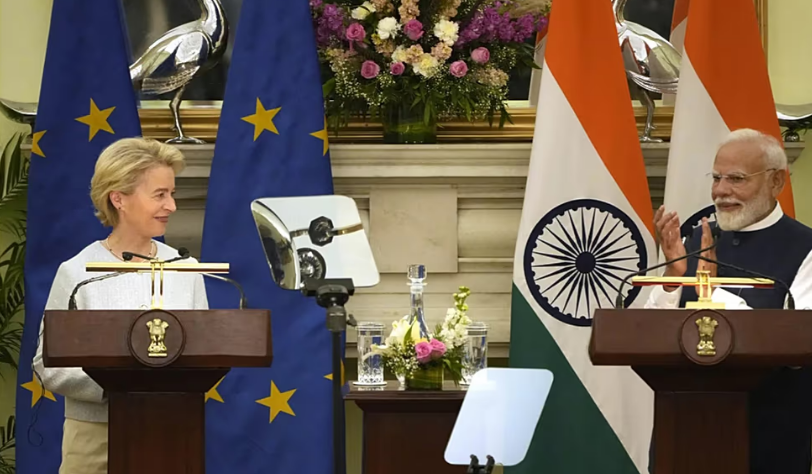
German Chancellor Friedrich Merz signaled strong support for the European Union’s trade agenda during a visit to India on Monday, including a free trade agreement with New Delhi and the recently approved Mercosur pact.
Merz said European Commission President Ursula von der Leyen and European Council President Antonio Costa could sign a free trade agreement with India by the end of the month. “EU leaders could travel to India towards the end of this month to take another major step forward to ensure that this free trade agreement comes into being,” he said at a press conference.
The remarks came days after a majority of EU member states approved the Mercosur trade pact, which Germany has championed as part of the bloc’s effort to diversify trade beyond the United States and China. Merz criticized a rise in protectionist measures worldwide, calling them a threat to “the principles of free trade and open markets.”
Merz described India as “the fastest growing economy of the G20” and a “pivotal partner in the Indo-Pacific,” highlighting the strategic importance of finalizing a deal. EU-India trade negotiations accelerated late last year, though an agreement had not been reached by the end of 2025. Last week, India’s Commerce and Industry Minister Piyush Goyal traveled to Brussels for talks with EU trade chief Maroš Šefčovič, who previously described Indian negotiators as “tough.”
Both India and the EU are navigating trade tensions with the US, which has raised tariffs on several partners, and China, which has sought to influence global access to raw materials and technology. The sustainability chapter of the EU-India deal has been particularly challenging, with disagreements over a dispute settlement mechanism tied to green standards and the EU’s Carbon Border Adjustment Mechanism, adopted in 2023.
Despite these hurdles, Merz expressed confidence that negotiations are nearing completion. He said the signing of the agreement would be “an encouraging sign on the path to continue down the road of forging and concluding free trade agreements.”
The Mercosur deal, which opens Latin American markets to EU exports, has sparked political unrest in France, the bloc’s second-largest economy. French officials expressed concerns that domestic farmers could face pressure from increased imports, prompting far-right and far-left parties to call for a vote of no confidence against President Emmanuel Macron. Von der Leyen is expected to travel to Paraguay on 17 January to formally sign the Mercosur pact, according to Euronews.
Germany’s backing of both the EU-India and Mercosur deals underscores its commitment to an open trade agenda, aiming to secure economic growth and strengthen strategic partnerships in an era of global protectionism.
