


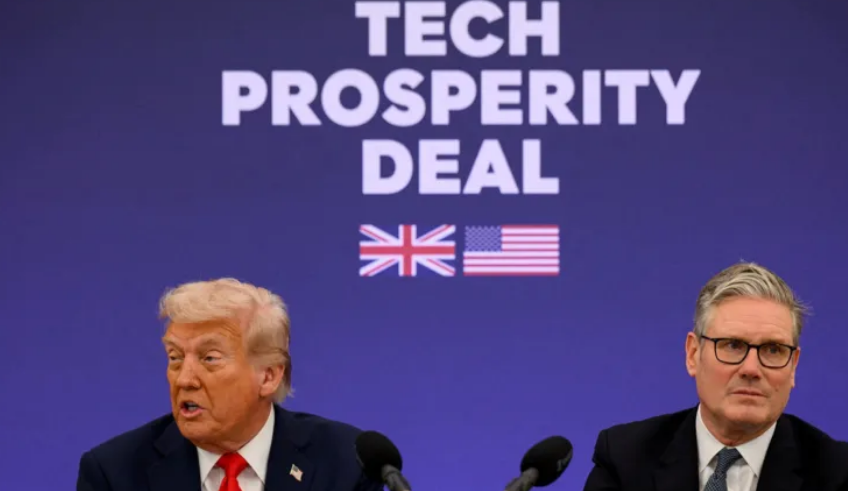
Negotiations over the UK-US Technology Prosperity Deal have hit a pause as broader trade disputes between the two countries create stumbling blocks, officials say. The agreement, announced during US President Donald Trump’s state visit in September, was hailed as “historic,” with both nations pledging cooperation in areas including artificial intelligence (AI), quantum computing, and nuclear energy.
A UK government spokesperson said, “Our special relationship with the US remains strong and the UK is firmly committed to ensuring the Tech Prosperity Deal delivers opportunity for hardworking people in both countries.”
The New York Times reported that discussions are being held up by US concerns over what it views as wider trade barriers in the UK, including digital regulations and food safety rules. The UK government declined to comment on these claims, and the White House has not responded to BBC requests for comment.
At the time of the deal’s unveiling, Prime Minister Sir Keir Starmer described it as a “generational step change in our relationship with the US, shaping the futures of millions of people on both sides of the Atlantic.” Technology Secretary Liz Kendall said the pact would “transform lives across Britain” and was a “vote of confidence in Britain’s booming AI sector.”
Alongside the announcement, US tech giants including Microsoft, Nvidia, and Google outlined a total of £31 billion in planned investment in the UK, mainly to scale up AI infrastructure such as data centres. Nvidia’s CEO Jensen Huang described his company’s UK investment as reflecting a belief the country could become an “AI superpower,” a goal championed by Starmer’s government. It is understood that these investment plans remain unaffected despite the delays in formalising the deal.
The Technology Prosperity Deal was documented in a Memorandum of Understanding (MOU), which sets out areas of potential collaboration but is not legally binding. It only “becomes operative alongside substantive progress being made to formalise and implement” the broader US-UK Economic Prosperity Deal, signed in May.
Trade negotiations between the two nations have involved a series of sector-specific deals, including on cars and pharmaceuticals. However, a proposed agreement to eliminate tariffs on UK steel exports has been put on hold indefinitely. Analysts say the pause over the tech deal is linked to this “piecemeal approach” to broader trade talks.
Allie Renison, director of communications firm SEC Newgate UK and a former government trade adviser, said, “Instead of having everything done at once, different areas are being linked to different parts.” She added that while questions remain over how the delay might affect US tech investment, it is likely “a bit of posturing in the wider negotiations.”
The impasse highlights the complexity of negotiating trade agreements in areas such as AI, where regulatory and economic considerations intersect with long-term strategic ambitions on both sides of the Atlantic.
