


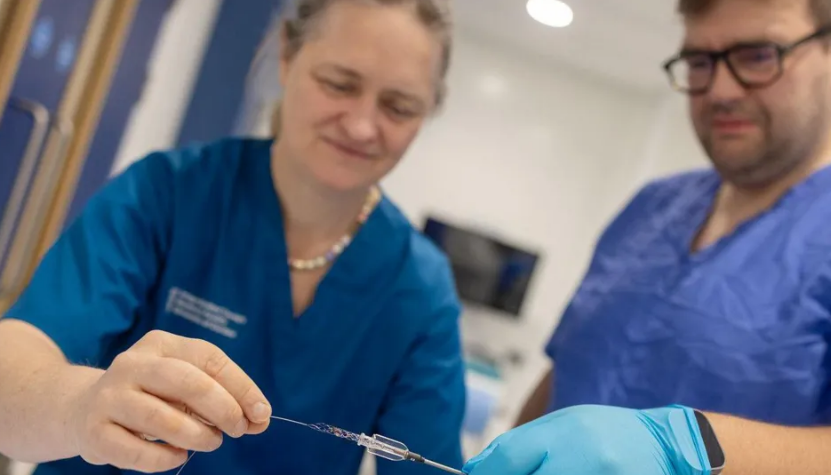
Doctors in Scotland and the United States have completed what is believed to be the world’s first remote-controlled stroke procedures, performing thrombectomies on human cadavers using robotic technology. The breakthrough could transform stroke care, offering rapid access to specialist treatment for patients in remote or underserved locations.
Prof Iris Grunwald of the University of Dundee conducted a remote thrombectomy on a donated human body at the university while physically located at Ninewells Hospital in Dundee. The procedure involved removing blood clots that block arteries in the brain during an ischaemic stroke, a condition that can cause rapid brain damage and permanent disability if not treated quickly.
Hours later, Dr Ricardo Hanel, a neurosurgeon based in Jacksonville, Florida, performed a similar procedure on a cadaver in Dundee from across the Atlantic, more than 6,400 kilometres away. Both doctors used a robotic system developed by Lithuanian firm Sentante, which allows surgeons to manipulate catheters and wires remotely while observing real-time X-rays. Prof Grunwald described the experience as remarkably tactile, saying her hands felt the same as during a conventional procedure. Dr Hanel noted that the robot responded with only a 120-millisecond delay, making transatlantic surgery possible.
The University of Dundee, which serves as the global training centre for the World Federation for Interventional Stroke Treatment, is the only UK institution where cadavers can be operated on with a liquid that mimics human blood. Four cadavers, all donated within the past three years, were used in the experiments to demonstrate that every step of a mechanical thrombectomy can be completed successfully.
Prof Grunwald highlighted two key challenges in stroke treatment: a shortage of trained thrombectomy specialists and the dependence of outcomes on patient location. In Scotland, only three centres—Dundee, Glasgow, and Edinburgh—offer the procedure. Delays in treatment reduce the likelihood of recovery, with a loss of one percent of good outcomes for every six minutes without intervention. In 2024, only 2.2% of ischaemic stroke patients in Scotland received a thrombectomy, compared to 3.9% across the rest of the UK.
Juliet Bouverie, chief executive of the Stroke Association, called the transatlantic demonstration “a remarkable innovation.” The technology could help bridge disparities in access to life-saving treatment, particularly in rural areas.
Prof Grunwald said the next step will be clinical trials, expected to begin next year, which could pave the way for routine use of remote thrombectomy on live patients. Sentante’s CEO, Edvardas Satkauskas, said the project shows how quickly futuristic medical solutions can become reality, with the potential to save thousands of lives by ensuring rapid treatment regardless of a patient’s location.
Tech partners Nvidia and Ericsson contributed to ensuring the connectivity and precision of the robotic system, demonstrating the role of advanced technology in expanding access to critical medical care.
