


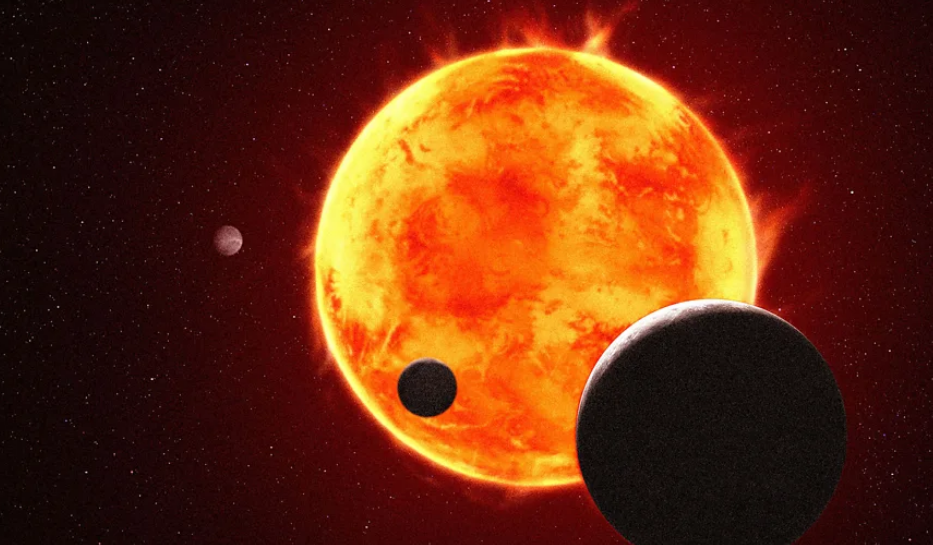
Nearly three decades after the discovery of the first planet orbiting a Sun-like star beyond our Solar System, astronomers continue their quest to find an Earth twin — a world capable of sustaining life. The breakthrough that ignited this pursuit was announced on 6 October 1995 at a scientific meeting in Florence, Italy, when Swiss astronomers Michel Mayor and Didier Queloz revealed the existence of a planet orbiting the star 51 Pegasi, about 50 light years away in the constellation Pegasus.
The newly discovered planet, named 51 Pegasi b, defied expectations. Unlike the gas giants found in our own Solar System, it was far closer to its star — completing an orbit in just 4.23 days — and was scorching hot, with surface temperatures exceeding 1,000°C. The detection was made possible by Elodie, a state-of-the-art spectrograph at the Haute-Provence Observatory in southern France. By analysing subtle shifts in the star’s light spectrum, Mayor and Queloz identified a rhythmic “wobble” caused by the gravitational pull of an unseen companion.
Initially met with scepticism, the discovery was soon confirmed by other teams. The planet’s proximity to its star challenged all existing theories of planetary formation, giving rise to a new class of exoplanets known as “hot Jupiters.” The finding not only reshaped astronomy but also earned Mayor and Queloz the 2019 Nobel Prize in Physics.
Since that groundbreaking moment, scientists have identified more than 6,000 confirmed exoplanets, revealing a staggering diversity of worlds — from ultra-hot gas giants orbiting their stars in less than a day to multi-planet systems resembling cosmic clockwork. Yet, none has truly mirrored Earth’s unique balance of size, mass, and temperature.
Today, the search continues with increasingly sophisticated tools. Astronomers like Christopher Watson and Annelies Mortier, part of an international consortium of exoplanet hunters, use advanced instruments such as the Harps-N spectrograph on the Telescopio Nazionale Galileo in La Palma, Spain. This device measures the faintest starlight movements, detecting the gravitational signatures of distant planets that have travelled across space for millennia.
Their mission is both scientific and philosophical — to determine whether planetary systems like our own are common, and whether life might exist elsewhere in the cosmos. The search also builds on a lineage of thought stretching back to ancient Greece, when philosophers like Epicurus speculated that “there is an infinite number of worlds, some like this world, others unlike it.”
Three decades after 51 Pegasi b’s discovery, humanity’s understanding of the Universe has been transformed. We now know that most stars host planets, yet the ultimate goal — finding another Earth — remains just out of reach. For modern astronomers, every flicker of starlight offers a new clue in that enduring search.
