


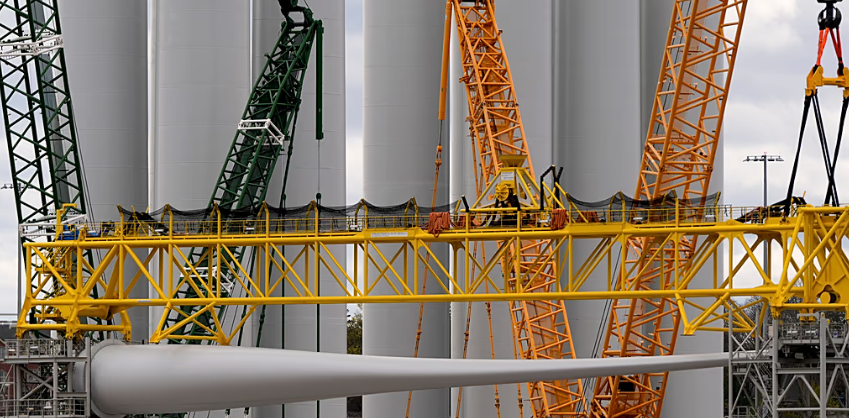
A federal judge has lifted the Trump administration’s pause on construction of Revolution Wind, a nearly completed offshore wind farm off the New England coast, allowing the Danish energy company Ørsted and its partner Skyborn Renewables to resume work on the $5 billion project.
The Bureau of Ocean Energy Management (BOEM) had ordered construction to stop on August 22, citing unspecified national security concerns. Both Rhode Island and Connecticut, the states backing the project, joined Ørsted in challenging the order in federal court.
On Monday, U.S. District Judge Royce Lamberth granted a preliminary injunction permitting construction to resume. He cited the project’s reliance on federal approvals, the financial harm of continued delays, and the risk of losing access to a specialized construction vessel, which would not be available again until 2028. “There is no question in my mind of irreparable harm to the plaintiffs,” Lamberth said. The judge noted that the project was already 80 percent complete and employed more than 1,000 workers.
In his ruling, Lamberth said Revolution Wind had “demonstrated likelihood of success on the merits” of its claim and that restarting construction was in the public interest. Following the decision, Ørsted confirmed it would resume work “as soon as possible” while continuing to cooperate with federal agencies. Shares in the company rose by 5 percent in European trading after the ruling.
The Interior Department acknowledged the ruling, stating that BOEM would continue investigating the project’s potential national security impacts. The administration has argued that while BOEM approved the wind farm, developers were required to work with the Department of Defense to address concerns, which it said remain unresolved.
Environmental groups welcomed the ruling. Nancy Pyne of the Sierra Club said it reaffirmed that the administration’s “attacks on clean energy” were unlawful and harmful to communities. Connecticut Attorney General William Tong and Rhode Island Attorney General Peter Neronha also praised the decision, calling it a win for families who depend on the project to lower energy costs.
Revolution Wind is set to become the first large-scale offshore wind farm serving Rhode Island and Connecticut, with capacity to power more than 350,000 homes—around 2.5 percent of the region’s electricity needs. Construction began in 2024, roughly 15 miles south of the Rhode Island coast.
The ruling marks a setback for President Trump, who has vowed to dismantle the offshore wind industry in favor of boosting fossil fuel production. His administration has canceled permits, halted construction, and cut funding for several wind projects across federal waters.
Despite political headwinds, supporters argue Revolution Wind is critical for diversifying New England’s energy supply and reducing reliance on fossil fuels. As Representative Joe Courtney of Connecticut noted, “A multibillion-dollar project that is 80 percent complete and was fully permitted with Pentagon input is not a national security problem.”
