


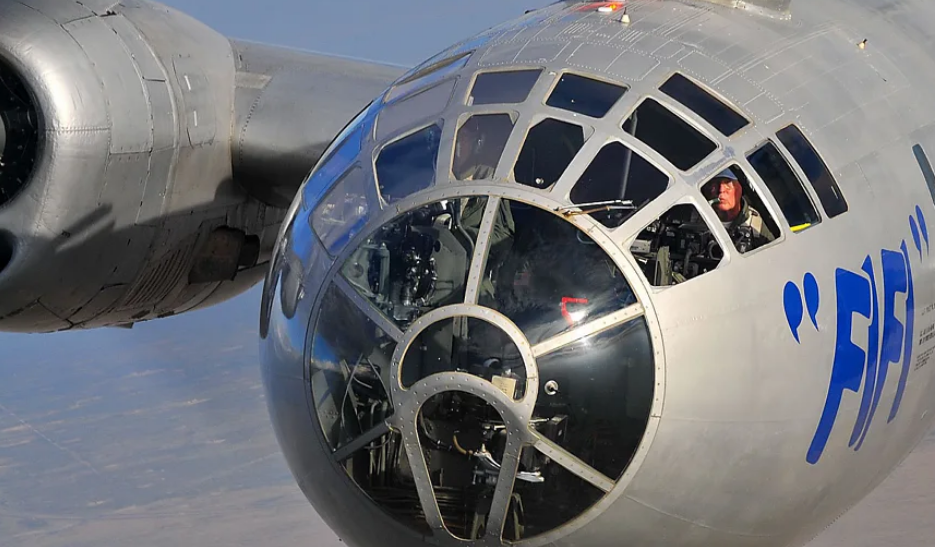
Nearly 80 years after they helped bring the Second World War to an end, two of the last surviving Boeing B-29 bombers are still flying – and thrilling crowds at air shows across the United States.
The Commemorative Air Force (CAF), a non-profit organisation dedicated to preserving historic military aircraft, operates the only two airworthy B-29s in existence out of nearly 4,000 originally built. Nicknamed Fifi and Doc, the bombers appear at summer events nationwide, where enthusiasts can even purchase seats for 30-minute demonstration flights.
When it entered service in 1945, the B-29 was the most advanced bomber in the world. It was the first mass-produced aircraft with pressurised crew compartments and boasted the ability to fly higher and farther than its contemporaries. With four powerful Wright R-3350 engines, the plane could almost match the speed of fighter aircraft. Developing and producing the bomber cost more than the atomic bombs that the B-29 would later deliver over Japan.
Despite its groundbreaking design, the aircraft was notoriously difficult to operate. Its massive engines were temperamental, often overheating without constant attention. Each B-29 required a dedicated flight engineer in addition to its pilot and co-pilot to manage engine power and performance.
For Randall Haskin, a US Air Force veteran and CAF pilot, flying the B-29 is both a privilege and a challenge. “Flying the Superfortress is like leadership by committee,” Haskin explained, noting that the flight engineer plays a central role in every decision about engine power. Unlike in other aircraft, the pilot must direct precise adjustments, measured by manifold pressure, to avoid disaster.
Weighing 40 tonnes and stretching 99 feet, the aircraft demands constant attention in the cockpit. “It’s like running a concert orchestra,” Haskin said. “If you’re not prepared for the unexpected, especially an engine failure, things can go wrong very quickly.”
Despite its size, the bomber is described as “underpowered” for take-off, often requiring long runways and careful handling to gain altitude. Even so, its history and unique character draw in both pilots and passengers eager for a once-in-a-lifetime experience.
For Haskin, the aircraft also carries personal meaning: his father served as a B-29 flight engineer in the 1950s. He calls the CAF’s flying museum a vital way to connect new generations to the “greatest generation” who built, flew, and maintained the aircraft during the war.
From its glass-nosed cockpit – which inspired the design of Star Wars’ Millennium Falcon – to its thunderous engines, the B-29 remains a powerful symbol of wartime innovation and sacrifice. For aviation fans, seeing Fifi or Doc take to the skies is more than a spectacle; it is a living link to history.
