


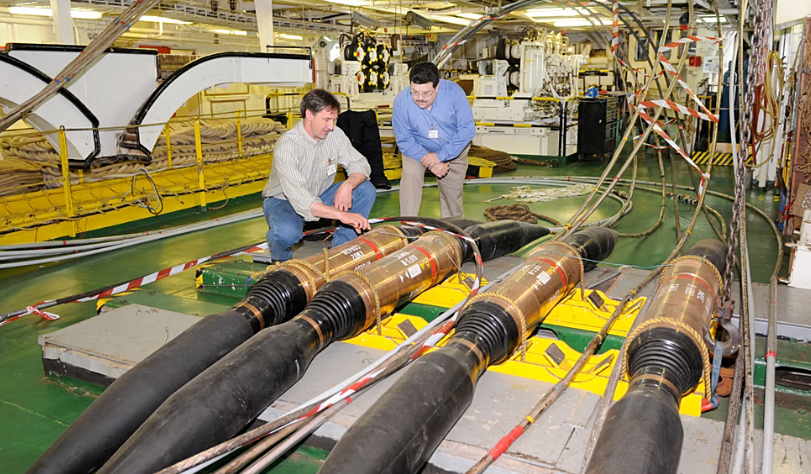
Two major subsea cables linking Europe to the Middle East and Asia were reportedly severed in the Red Sea over the weekend, disrupting internet services across parts of the Middle East, South Asia and beyond. The cause of the incident remains unclear, though analysts say the region’s heavy maritime traffic and geopolitical tensions make the undersea network particularly vulnerable.
Cybersecurity watchdog NetBlocks confirmed outages on Sunday, attributing the disruption to failures on the South East Asia-Middle East-Western Europe 4 (SMW4) and India-Middle East-Western Europe (IMEWE) cable systems near Jeddah, Saudi Arabia. The two cables form part of the global backbone of the internet, carrying vast amounts of international data traffic between Europe and Asia.
“The subsea cable outages in the Red Sea have degraded internet connectivity in multiple countries,” NetBlocks said, naming India and Pakistan among the most affected. Users in the United Arab Emirates also reported slower browsing and difficulties with streaming and messaging apps on state-owned providers Etisalat and Du.
Kuwaiti officials confirmed that the FALCON GCX cable was also cut, compounding disruptions in the Gulf state. However, telecom operator GCX has not publicly commented. In Saudi Arabia, where the damage reportedly occurred, officials have yet to acknowledge the incident.
The SMW4 cable, an 18,800-kilometre system operational since 2005, connects France and Italy to countries across North Africa and Asia, including Egypt, Saudi Arabia, the UAE, India, Pakistan and Singapore. The project, which cost $500 million, was jointly built by France’s Alcatel Submarine Networks and Japan’s Fujitsu. The IMEWE cable, launched in 2010 at a cost of $480 million, spans more than 12,000 kilometres, linking Europe to India through the Middle East.
The Red Sea is one of the world’s most critical digital corridors, carrying around 17 per cent of global internet traffic, according to telecom research firm TeleGeography. Even localised faults can ripple across continents, impacting cloud services, banking platforms and airline systems.
Speculation over possible sabotage has heightened since Yemen’s Houthi rebels launched attacks on shipping in the Red Sea as part of their campaign to pressure Israel over the war in Gaza. While the group has previously denied targeting undersea infrastructure, concerns remain over the cables’ vulnerability.
The International Cable Protection Committee estimates there are around 1.7 million kilometres of undersea cables worldwide, with 150 to 200 incidents recorded annually. Most are caused by human activity, such as fishing or ship anchors, while the remainder are linked to natural hazards like earthquakes.
Repairing damaged cables is a complex and costly process that can take weeks. With no immediate clarity on the cause of the Red Sea cuts or a timeline for repairs, millions of users across the region may continue to face disruptions in the coming days.
