


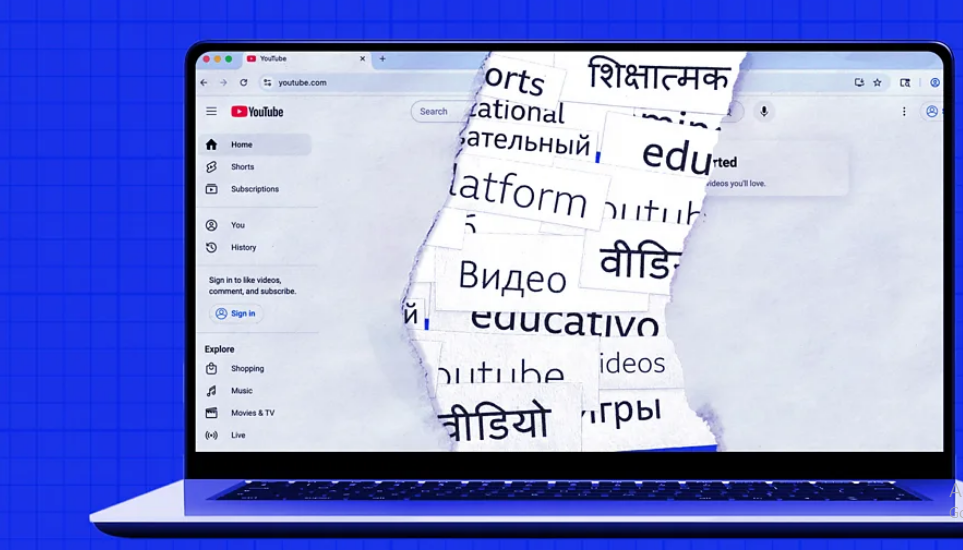
A new study has revealed that language plays a far greater role in shaping online experiences than many users realise, with platforms like YouTube functioning as entirely different ecosystems depending on the linguistic community.
Researchers at the University of Massachusetts Amherst’s Initiative for Digital Public Infrastructure examined the platform across four major languages — English, Hindi, Russian and Spanish — and found striking cultural and behavioural differences. The findings challenge the common assumption that the English-speaking internet reflects the global web.
Most online activity is concentrated on a small number of platforms, but language acts as a powerful filter, shaping what users see, share and engage with. Algorithms designed to maximise engagement rarely recommend content in languages the user does not understand, leaving much of the internet hidden from view.
To better understand the scope of these differences, the research team developed a novel method for sampling YouTube content, randomly generating billions of URLs to capture a large, representative dataset. They then compared trends across languages, focusing on metrics such as video length, category and engagement patterns.
The most dramatic differences emerged in Hindi-language YouTube. More than half of all Hindi videos in the sample were uploaded in 2023 alone, and the median length was just 29 seconds — far shorter than English (two minutes), Spanish (two and a half minutes) or Russian (one minute 38 seconds). Researchers linked this to India’s 2020 ban on TikTok, which prompted YouTube to launch its Shorts format in the country, filling the gap for short-form video content. Today, 58% of Hindi YouTube content is Shorts, compared with 25–31% in other languages.
Category preferences also diverged sharply. While gaming dominated English, Spanish and Russian content outside the default “People & Blogs” classification, Hindi creators leaned more towards entertainment and education. Political content, often highlighted in English-language discourse, was least common among English videos in the study.
Engagement patterns in India stood out as well. Just 0.1% of Hindi videos accounted for 79% of total views, but even little-seen videos received disproportionately high numbers of likes, suggesting YouTube is often used as a form of personal or community communication.
According to the researchers, these findings show that internet platforms cannot be fully understood without considering language and culture. The Hindi YouTube experience, shaped by geopolitical events and platform design, points to a more intimate, small-scale form of engagement — one that differs significantly from the mass-audience focus in other linguistic spheres.
The study’s authors say these insights highlight the need for broader, language-aware research to capture the diverse ways people around the world are using the web.
