


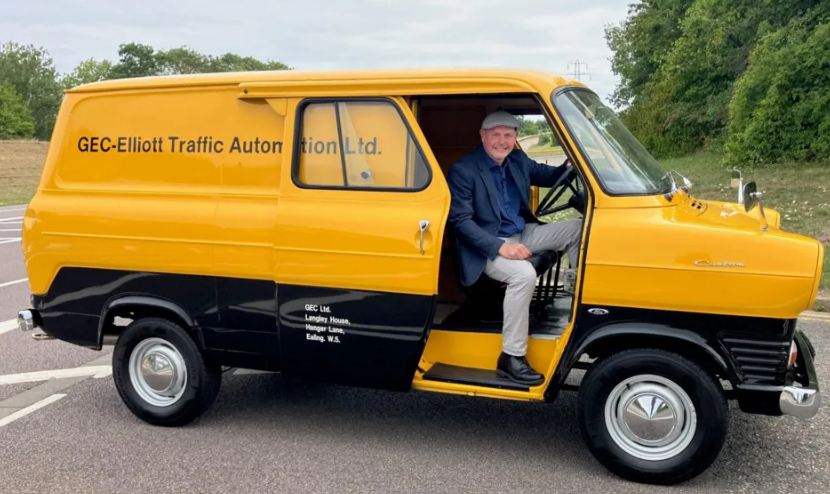
Climbing into a 1965 Ford Transit is like stepping back in time. There’s no satnav, touchscreen, or even a radio—just a steering wheel, a large chrome speedometer, and a chunky heater control. On the road, the ride is rattly, the brakes sluggish, and the seatbelt nonexistent. Yet when it first rolled off the production line in Langley, Berkshire, on August 9, 1965, the Transit was a revolution.
Spacious, powerful, and comfortable, it outperformed rivals like the Morris J4 and quickly became the go-to van for tradespeople, from builders and electricians to delivery drivers. It also became the vehicle of choice for rock bands on the road—Black Sabbath, Led Zeppelin, and Slade among them—offering cheap, versatile transport in an era of low fuel prices.
By the 1970s, the Transit had another, less savoury reputation. Its speed and load capacity made it an ideal getaway vehicle, with a Metropolitan Police spokesman once claiming it was used in 95% of bank raids—earning it the nickname “Britain’s most wanted van.”
Over six decades, the Transit has been redesigned many times, becoming the world’s best-selling van with over 13 million produced. Once a symbol of British manufacturing, it was built in the UK until 2013, when Ford moved production to Turkey, citing lower costs—a move unions called a betrayal. Today, design and engineering remain in Dunton, Essex, while diesel engines are built in Dagenham and electric power packs in Halewood.
Lisa Brankin, Ford of Britain’s managing director, insists the van’s heritage is still central to its identity. “Dunton is the home of the Transit,” she says. “We’re still leading the engineering and design work here.”
The Transit’s next chapter will focus on electrification and smarter software. Seamus McDermott, Ford’s director of commercial vehicle development, says the aim remains the same as in 1965: reliable, versatile, cost-effective transport. But the tools have changed. “Electric vehicles are cheaper to run and repair,” he explains. “Smarter, software-defined vehicles will allow fleet management to be more efficient and reduce costs.”
However, the road ahead may not be as straightforward. AA president Edmund King warns that fierce competition could erode the Transit’s once-ironclad brand loyalty. “In the past, if someone’s father had a Transit, they’d get one too,” he says. “Now, there’s more choice, and loyalty isn’t as strong as it used to be.”
Still, after 60 years, the Transit remains an icon—a van that defined a market, carried rock stars, tradespeople, and even bank robbers, and is now steering towards an electric future.
