


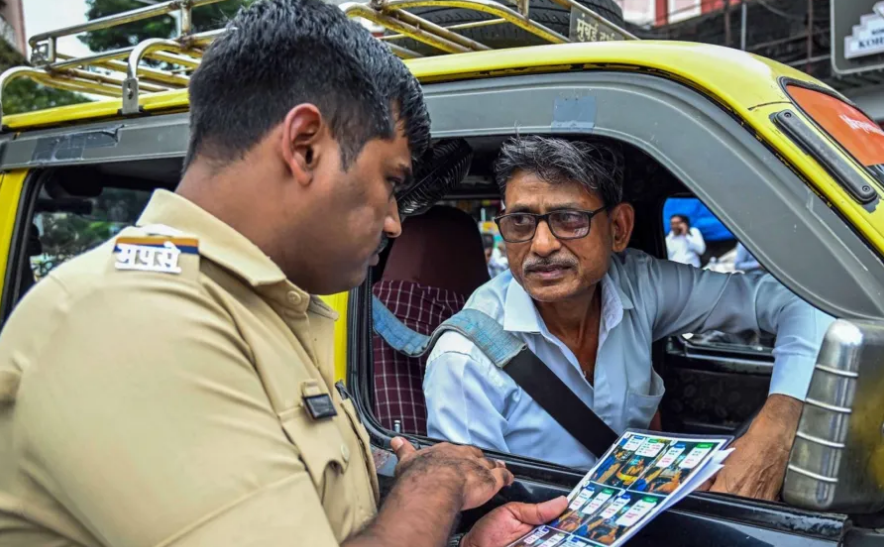
Taxi and tuk-tuk drivers in India’s Maharashtra state have been given an additional year to learn Marathi after protests erupted over new rules requiring them to demonstrate basic knowledge of the local language.
Transport authorities began testing drivers on their ability to hold simple conversations in Marathi, the state’s official language, on August 20. Drivers who failed were initially given one month to improve their language skills, with the possibility of having their licences suspended or cancelled if they did not meet the requirement.
The state government said the rule was designed to improve communication between drivers and passengers and make journeys safer.
Drivers’ unions objected to the initial deadline, arguing that workers should not risk losing their livelihoods while trying to learn the language. Many drivers are migrants who moved to Maharashtra for employment from other parts of India, particularly the Hindi-speaking states of Uttar Pradesh and Bihar.
Chief Minister Devendra Fadnavis announced last week that drivers would receive another year to meet the requirement. He said many workers had been away from formal education for years and needed additional time to acquire the necessary language skills.
Transport Minister Pratap Sarnaik said drivers would be expected to learn Marathi during the extended period and suggested that further extensions could be considered.
Maharashtra has nearly 979,000 valid taxi and tuk-tuk permits, with almost half operating in the Mumbai metropolitan region.
The extension has eased concerns among drivers who feared losing their income. Mumbai taxi driver Lakhan Pandey said workers had been worried about licence suspensions but now felt more secure.
The dispute has also revived a long-running debate over language, migration and employment in Maharashtra. The state was created in 1960 following a campaign for a Marathi-speaking region, and language has remained closely connected to questions about local identity and access to jobs.
The Shiv Sena, founded in 1966 on a platform focused on protecting employment opportunities for Marathi speakers, helped make the issue a major part of state politics. Today, several political groups continue to campaign around Marathi identity.
The government says drivers are not required to read or write Marathi or speak it fluently. They only need a working knowledge that allows them to communicate with passengers.
Training courses focus on practical phrases, including asking passengers where they are travelling, discussing fares and giving directions. About 166,000 drivers have completed the training and passed an oral examination.
Some drivers say finding time for classes remains difficult. Mumbai taxi driver Ajay Singh said he works from morning until late at night and cannot easily sacrifice several hours of income for lessons.
Drivers such as Pandey say they are willing to learn Marathi but want sufficient time to do so without putting their families’ finances at risk. He said learning the local language was reasonable for people living and working in Maharashtra, provided workers were given time to meet the requirement.
