


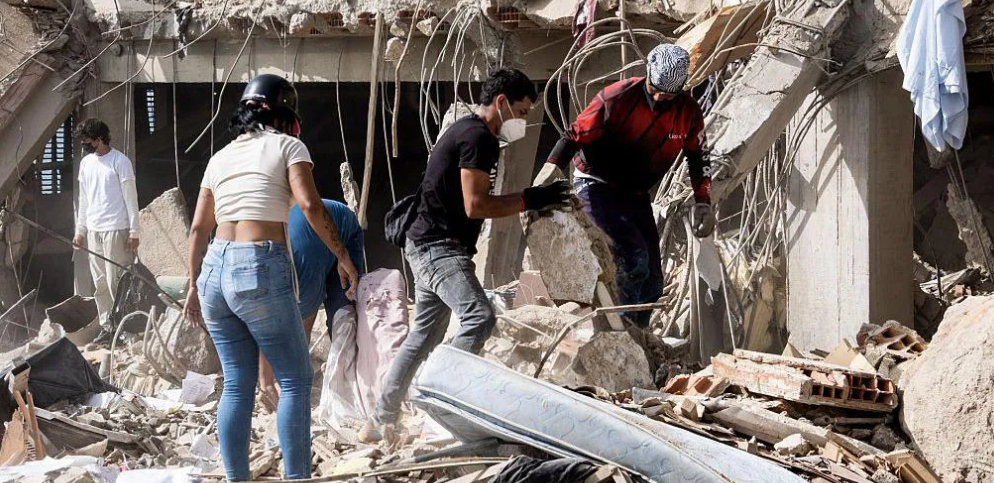
Rescue workers and volunteers continued searching through the rubble across Venezuela on Saturday as the death toll from this week’s devastating earthquakes climbed to at least 1,430, with thousands of people still believed to be trapped beneath collapsed buildings.
The twin earthquakes, measuring 7.2 and 7.5 in magnitude, struck on Wednesday, causing widespread destruction across the coastal state of La Guaira and parts of the capital, Caracas. The United Nations estimates that around 50,000 people remain missing as emergency crews race against time to locate survivors.
Teams armed with shovels and bare hands searched through mountains of debris while drones scanned damaged neighborhoods for signs of life. Humanitarian agencies say the first 48 to 72 hours after a disaster offer the greatest chance of rescuing survivors, though that window can be extended if trapped victims have access to food and water.
La Guaira remains one of the worst-hit regions, where hundreds of buildings have collapsed and many neighborhoods have been reduced to rubble.
National Assembly President Jorge Rodríguez acknowledged the scale of the disaster, saying every successful rescue offers hope to grieving families.
Residents, however, say the shortage of heavy rescue equipment has slowed efforts. In Catia La Mar, Jesús Suárez traveled about 200 kilometers searching for his missing son after learning he had not escaped from a collapsed building.
“There is no sophisticated equipment here,” Suárez said. “A person alone cannot rescue someone trapped beneath all this.”
Nearby, relatives of 31-year-old Carlos Eduardo said they had heard him groaning beneath the debris but had been unable to reach him. They continue waiting for rescue teams capable of lifting the concrete slabs.
Emergency workers and soldiers have repeatedly called for silence at rescue sites so they can listen for voices or tapping beneath the rubble. Volunteers have also deployed drones to inspect areas too dangerous for rescuers to enter, while anxious families study the aerial images hoping to identify missing relatives or belongings.
As recovery efforts continue, residents say the growing number of unrecovered bodies has created additional health concerns.
“There is a smell everywhere,” said local resident Glendys Delgado, who said no government rescue teams had reached her neighborhood. She credited volunteers arriving from Caracas with providing food and assistance.
Authorities said more than 860 international rescue personnel from countries including Mexico, Spain, the United States, the United Kingdom, Colombia, El Salvador and Switzerland are assisting search operations, with additional teams expected to arrive.
Interim President Delcy Rodríguez said she had spoken with US President Donald Trump and Secretary of State Marco Rubio, who pledged additional rescue teams and humanitarian aid.
For many survivors, the emotional toll continues to grow. Alexandra Gabino, whose family escaped when the earthquakes struck, is now sheltering with her husband and two children in their car near Simón Bolívar International Airport after losing their home.
“You try to stay strong for your children,” she said. “People tell you that being alive is what matters, but seeing so much suffering and losing everything is deeply painful.”
