


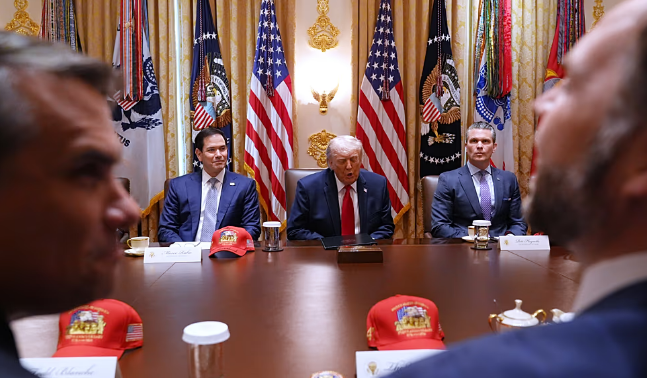
US President Donald Trump has said he is not satisfied with Iran’s latest proposals in ongoing negotiations over a potential agreement to end the conflict between Washington and Tehran, warning that failure to reach a deal could lead to further military action.
Speaking at a White House cabinet meeting on Wednesday, Trump said the United States was still evaluating Iran’s position but insisted he was “not in a rush” to conclude talks, despite earlier suggestions that a breakthrough was close.
“Iran is very much intent, they want very much to make a deal. So far they haven’t gotten there. We’re not satisfied with it, but we will be,” Trump said, adding that if negotiations fail, the US would “have to finish the job.”
His comments came after Iranian state media reported details of what it described as a draft memorandum of understanding with Washington. The report claimed the outline included provisions to lift a naval blockade, restore shipping through the Strait of Hormuz and reduce US military presence in the Gulf. The White House rejected the claim outright, calling it a “complete fabrication.”
Tensions remain high following months of conflict that began on 28 February, when military operations involving the US and Israel escalated before a pause in April. Iran’s Islamic Revolutionary Guard Corps responded to renewed threats of military action by warning that it would turn the coastline into a “graveyard for aggressors.”
Trump dismissed such statements, saying Iran was “negotiating on fumes” and would not control key maritime routes. He also rejected suggestions that Iran or regional partners could administer any toll system for the Strait of Hormuz, a critical global oil shipping lane.
During the meeting, Trump went further, stating that “nobody” would be allowed to control the waterway and warning that any attempt to do so would be met with force. He also suggested that countries such as Oman would need to align with US expectations or face consequences, a remark that appeared directed at Iran’s regional partners.
The president also linked the negotiations to broader regional diplomacy, saying a potential agreement could depend on Gulf states joining the Abraham Accords to normalise relations with Israel. “I’m not sure we should make the deal if they don’t sign,” he said.
On the issue of Iran’s nuclear programme, Trump indicated flexibility on temporary arrangements regarding enriched uranium stocks, describing the current discussions as a “memorandum of understanding for speed,” while ruling out Russia or China as possible custodians of Iranian nuclear material.
US Secretary of State Marco Rubio, who attended the meeting, said there had been “some progress and some interest” in the ongoing talks, though major differences remain unresolved.
