


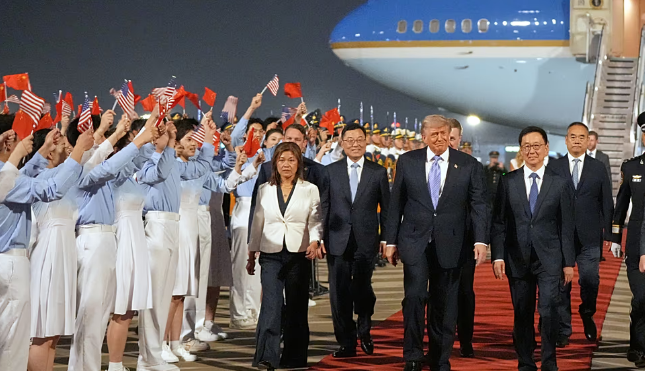
Several of America’s most influential technology executives joined US President Donald Trump in Beijing this week for talks with Chinese President Xi Jinping, highlighting the deep commercial ties that continue to connect US tech companies with China despite years of political and trade tensions.
Among those attending the summit are Jensen Huang, Tim Cook and Elon Musk, each representing companies with major operations, investments or supply chain links in China.
The White House said the summit aims to encourage China to expand market access for American firms and improve dialogue on trade, artificial intelligence and broader economic issues.
Nvidia’s relationship with China stretches back more than a decade. The semiconductor company began working with Chinese universities in 2011 to promote use of its CUDA software for artificial intelligence development. By 2017, Nvidia chips were being used by major Chinese technology companies including Baidu, Tencent and Alibaba.
However, Nvidia’s business in China has faced mounting pressure from US export controls introduced during former president Joe Biden’s administration. Restrictions on advanced AI chips limited the company’s ability to sell its most powerful processors to Chinese customers.
To continue operating in the market, Nvidia developed modified chips that complied with US regulations. Even so, additional restrictions and Chinese security concerns have reduced the company’s market share in the country. Chinese firms including Huawei, along with AI developers such as DeepSeek, have increasingly developed domestic alternatives to Nvidia products.
Apple also maintains extensive links with China through manufacturing and supply chains built over decades. The company began expanding production in China in the late 1990s and steadily shifted much of its manufacturing there during the early 2000s through partnerships with suppliers including Foxconn.
Cook has repeatedly played a role in managing tensions between Washington and Beijing, particularly during earlier trade disputes. Apple has also secured tariff exemptions in past negotiations with the US government while continuing major investments in China.
The company signed a multibillion-dollar agreement in 2021 aimed at easing regulatory pressure on its operations in the country and later announced plans for an energy investment fund supporting projects in China.
Tesla’s ties with China have also grown substantially under Musk. The electric vehicle maker entered the Chinese market more than a decade ago and initially struggled to gain traction. Sales later accelerated, and in 2019 Tesla opened its large manufacturing facility in Shanghai.
The Shanghai plant has since become one of Tesla’s most important production centres, manufacturing millions of vehicles for both domestic and international markets.
The presence of leading American technology executives at the Beijing summit underlines how deeply interconnected the US and Chinese economies remain, even as disputes continue over trade, semiconductors, artificial intelligence and national security.
