


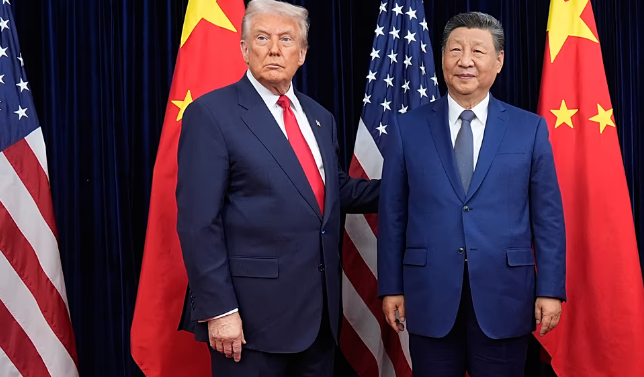
US President Donald Trump arrives in Beijing this week facing mounting political and economic pressure at home, as the prolonged conflict in Iran, rising oil prices and slipping approval ratings complicate what was expected to be a major diplomatic moment in his second term.
Trump’s meeting with Chinese President Xi Jinping on Thursday and Friday had originally been planned weeks earlier, but was postponed after the United States launched military action against Iran. At the time, the White House had hoped for a swift resolution to the conflict.
Instead, the war has dragged on for more than two months, sending global energy prices sharply higher and increasing pressure on the US administration ahead of November’s midterm elections.
Analysts say the shift in circumstances has weakened Washington’s bargaining position and strengthened Beijing’s hand ahead of the summit.
Jonathan Czin, a China expert at the Brookings Institution, said the diplomacy surrounding the summit had reduced the likelihood of major breakthroughs.
“By signalling early and loudly a desire for multiple presidential encounters this year, the Trump administration may have reduced Beijing’s incentive to offer any major concessions,” he said.
One of Trump’s main goals during the visit is expected to be persuading China to pressure Iran into ending the conflict and reopening the Strait of Hormuz, a critical route for global oil supplies.
China, however, has shown little sign of wanting to become directly involved. Beijing has largely portrayed the crisis as a consequence of US policy while focusing on protecting its own economic and energy interests.
Alicia Garcia-Herrero of Brussels-based think tank Bruegel said China had adopted a cautious approach that avoided crossing Washington’s red lines while publicly opposing US actions.
Despite the tensions, China appears relatively well-positioned to handle the energy shock. The country has expanded strategic oil reserves and invested heavily in renewable energy in recent years, reducing its vulnerability to supply disruptions.
At the same time, Beijing remains concerned about the risk of a broader global economic slowdown that could damage exports and weaken already sluggish domestic demand.
Trade is expected to dominate much of the talks. Trump is travelling with a delegation of major American business leaders, including Elon Musk, in what the White House says is an effort to expand economic cooperation.
Executives from companies including Boeing, Apple, Meta, Goldman Sachs and Qualcomm are expected to participate in discussions on trade, technology and supply chains.
China is reportedly seeking an extension of the current tariff truce and a relaxation of US restrictions on advanced semiconductor exports, which Beijing views as a major obstacle to its ambitions in artificial intelligence and high-tech manufacturing.
European governments are also watching the summit closely. Officials in Brussels fear a renewed trade confrontation between Washington and Beijing could damage European industries through weaker demand, supply chain disruptions and redirected Chinese exports flooding European markets.
There are also concerns that the United States could secure preferential access to Chinese rare earth supplies while leaving European allies exposed.
Jonas Parello-Plesner of the German Marshall Fund warned that Europe risked becoming collateral damage if the talks focused solely on bilateral US-China interests.
“Trump will only speak for himself,” he said.
