


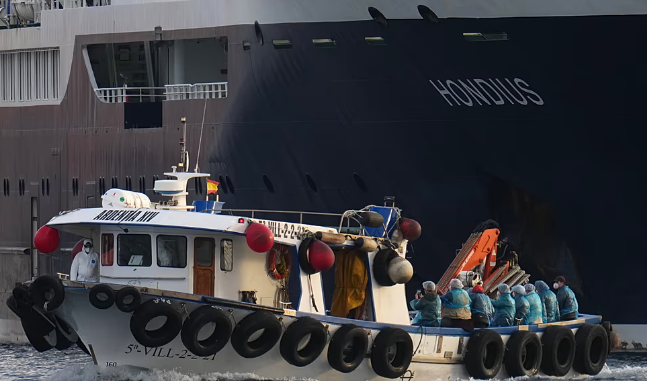
A Dutch cruise ship linked to a deadly hantavirus outbreak was forced to dock again in Spain’s Canary Islands on Monday evening after strong winds and rough seas disrupted evacuation operations, Spanish authorities said.
The MV Hondius had been heading toward the Netherlands, where officials planned to complete the repatriation of the remaining 28 passengers on board.
Spanish maritime authorities recommended the temporary docking at the port of Granadilla in Tenerife after weather conditions made it unsafe for the vessel to continue evacuation procedures at sea.
Officials said strong gusts repeatedly pushed the ship off course during manoeuvres lasting more than an hour. Attempts to stabilise the vessel proved unsuccessful as high waves and shifting winds complicated operations.
Spain’s Health Minister Mónica García defended the decision, saying passenger safety remained the priority.
“For meteorological reasons and following the recommendation of the maritime authorities, the MV Hondius has been temporarily moored in the Port of Granadilla,” García said. “The strong wind and waves made it safer for the passengers to disembark and for evacuation teams to work.”
The ship has been at the centre of an international health operation after multiple hantavirus cases were linked to passengers on board. Three passengers have died since the outbreak began during the voyage, while several confirmed and suspected infections have been reported among travellers from different countries.
Spanish health authorities said Monday evening that one of the 14 Spanish nationals evacuated from the ship had tested provisionally positive for hantavirus at Madrid’s Gómez Ulla Hospital.
The patient remains isolated and has not shown symptoms, while the remaining evacuees tested negative and continue to remain in quarantine under medical supervision.
The outbreak has prompted warnings from the World Health Organization, which said additional cases could emerge in the coming weeks because of the virus’s long incubation period.
Olivier Le Polain, head of the WHO epidemiology unit, said authorities needed to remain alert as symptoms may not appear immediately after exposure.
“We may see cases in the next few days or next week, so we need to be vigilant,” he said, explaining that the incubation period can last up to six weeks, although the average is closer to three weeks.
The crisis has triggered close coordination between Spanish authorities and international health agencies. Spanish Prime Minister Pedro Sánchez is scheduled to meet WHO Director-General Tedros Adhanom Ghebreyesus at the Moncloa Palace on Tuesday morning to review the handling of the outbreak and ongoing repatriation efforts.
The two leaders are expected to hold a joint press conference following their meeting.
Health officials continue to stress that the overall public health risk remains low despite the international concern surrounding the outbreak.
